
How to reschedule production when a machine breaks down
When a machine breaks down, find everything it touches, including material hold times, QC samples and maintenance windows. Then move only that. A guide for planners.
 31 Oct 20269 min read
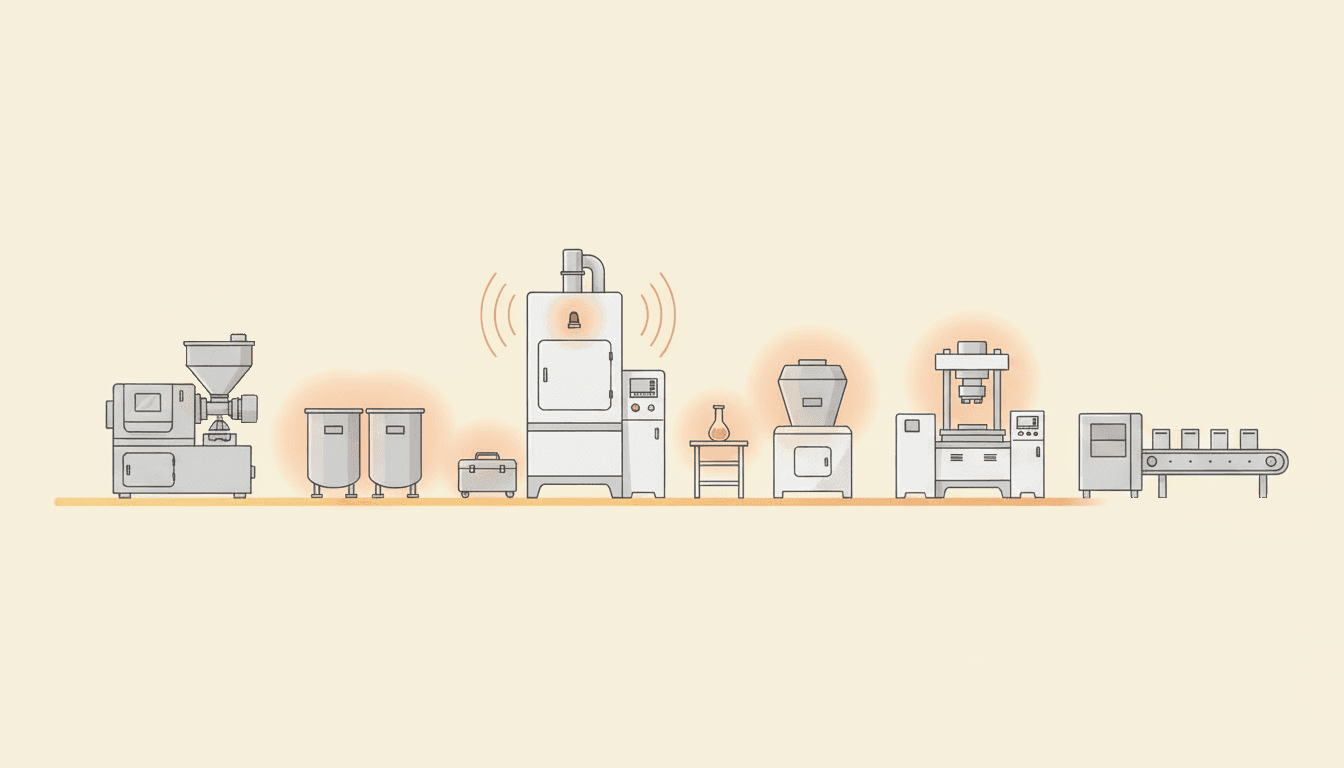
When a machine breaks down, find everything it touches before you move anything. That means the tasks on it, the materials and their hold times, the QC and maintenance work, and the dates at risk. Then re-plan against every constraint. Move only what the breakdown touches, and tell everyone downstream.
That is the short answer. The rest of this guide is the long version. It is written for production planners and schedulers in regulated process manufacturing. In these plants, a breakdown rarely stays inside production.
The events that break a plan are few and familiar
A plant does not need a forecast to know what will disrupt next week's plan. Five events cause most of it:
- An equipment trip. A machine stops, and nobody knows yet if it is a reset or a repair.
- A batch running long. A step takes hours longer than planned.
- A QC hold or an out-of-specification (OOS) result. The batch cannot move to the next step.
- Late material. A lot arrives late, arrives short, or goes on hold.
- An absent operator. The person booked for a task is not there.
None of them is a surprise in kind, only in timing. Familiar events mean you can plan the response. You do not have to invent it each time.
This guide uses the breakdown as the worked case, because it reaches furthest. The same method works for the other four.
Production rescheduling after an equipment breakdown: what it touches
Take an illustrative example. A fluid bed dryer trips partway through drying Batch A. Maintenance is on its way.
The obvious impact is the batch on the dryer. The rest is where the morning goes:
- The batch itself. A trip in the middle of drying is a deviation, so QA needs to know. Whether the batch resumes or is reprocessed is QA's decision, not a scheduling one.
- Material hold times. The wet granules now wait on an intermediate hold time. Each material in the chain has a maximum hold before it expires. Some also need a minimum wait before the next step can use them. A breakdown can break either limit.
- Requalification. After the repair, the dryer may need cleaning, checks or requalification before it can take a batch.
- What feeds it. Granulation for Batch B was due to load the dryer next. Its granules now wait too, against their own maximum hold time.
- Downstream equipment. The blender, the tablet press and the packaging line were booked around Batch A. Their slots open, and something else could use them.
- The QC lab. The in-process sample timed to the end of drying moves. So does the analyst booked to test it, and the lab slot.
- Maintenance. The repair needs a technician, parts and a window. If the technician comes off a planned preventive maintenance (PM) job, that PM needs a new window.
- People. The operators booked on the next step are free, but only for tasks they are qualified for.
A plan held at batch level shows you the dryer and Batch A. A task-level schedule shows who does each task, on which equipment and when. That puts the rest of the list in front of the planner.
Manual vs automated rescheduling: why a hand patch breaks something downstream
The usual response is a hand patch. Move Batch B to another dryer. Push the next batch back. Call the line. It is fast, and it fixes the gap the planner can see.
The trouble is what the planner cannot see from the spreadsheet. Two hours later, the granules pass their intermediate hold time. The lab gets two samples for one slot. The PM window the technician came from is gone. Each knock-on surfaces when the floor runs into it.
A hand patch does not fail because it moves too much. It fails because it moves the few tasks the planner can see, and misses the ones they cannot.
So the rule has two halves:
- Find everything the event touches. Check the change against every constraint: equipment, people and their qualifications, materials and their hold times, QC capacity and maintenance windows.
- Then move only what it touches. Keep work in progress where it is. Keep the rest of the plan fixed. A schedule that reshuffles on every event teaches the floor to ignore it.
By hand, the first half takes a morning. That is the case for automated rescheduling. It does not replace the planner's judgment. It does the search the planner has no time for.
Five questions decide which tasks move
Before anything moves, answer five questions:
- What does the event block, and for how long? A reset and a three-day repair need different responses. If the estimate is unsure, plan for the likely case and set a time to look again.
- Which material hold times does it put at risk? An intermediate that waits too long passes its maximum hold and expires. One that is used too early breaks its minimum wait. These limits often set the real deadline, before the repair does.
- What is in progress and cannot move? Tasks already started, or already released to the floor, stay where they are.
- Which commitments are at risk? Release dates, client slots and shipments.
- Who downstream has to act? Supervisors, the QC lab, maintenance, the warehouse, and customer service if a date moves.
Why this takes a morning by hand
None of the five questions is hard on its own. The difficulty is that each answer lives somewhere else.
Equipment status sits in the Manufacturing Execution System (MES) or the maintenance system. Operator qualifications sit in the training records. Sample schedules sit in the Laboratory Information Management System (LIMS). Material status sits in the ERP. Hold times often sit in a batch record or someone's head.
So the planner collects answers by phone, on a call, or in a WhatsApp group. The response is only as current as the last message.
What changes with agentic rescheduling
Bodhee Production Scheduling treats events as inputs to the schedule, not interruptions to it.
- The event is registered as it happens. Agents detect it when it is logged in a connected system, or when the shift lead logs it.
- The impact is assessed across Production, QC and Maintenance. Material hold times are modeled as time-based constraints: the minimum wait before an intermediate is used, and the maximum hold before it expires.
- The schedule is re-solved. Bodhee re-solves against every live constraint, keeps work in progress where it is, and moves only what the event touches.
- The planner sees what a change would break before it commits. Every recommendation is explainable, and the planner approves it before release.
- The change is visible downstream. Supervisors, the QC lab and maintenance see the new plan, not last week's printout.
Bodhee deploys alongside your existing ERP (SAP, Oracle) and MES. In deployments, the rescheduling cycle has moved from hours to minutes, and planner scheduling effort has fallen by 60–80%. Based on Neewee deployment observations in regulated process manufacturing.
QA's decision on the batch itself stays with QA. The planner's decision on the plan stays with the planner. What changes is how early they see the options.
The same method, when the event is a person
Now take an absent operator. If only one trained operator can run a step, the gap does not stay on that step. Everything behind it waits, and the materials in between move closer to their maximum hold time.
The five questions still apply. The constraint that matters most is qualification, not equipment. For a full worked example of that case, read Who can run the batch?
See it on a live schedule
Our video "Three disruptions, one schedule" follows three events on one API line. They are a reactor breakdown, a late in-process QC result and a filtration step that runs over. The equipment chapter shows this guide's method on a real plan. Watch the video
FAQ
Should you reschedule the whole plan after a machine breaks down?
No. Check every constraint the breakdown could affect, then move only what it touches. Rebuilding everything on every event makes the schedule unstable, and the floor stops following it.
What is the difference between manual and automated production rescheduling?
A manual reschedule moves the tasks the planner can see, so knock-ons surface later. Automated rescheduling checks the change against every constraint first. The planner still approves what goes to the floor.
How do you keep QC and production schedules in sync after a disruption?
Schedule them from the same plan. When production moves, the in-process samples and lab slots tied to it move in the same pass. Bodhee Quality Control Scheduling does this where it runs alongside Production Scheduling.
What is dynamic scheduling in manufacturing?
Dynamic scheduling updates the plan when events happen on the floor, instead of waiting for the next weekly run. Read more in How dynamic production scheduling works.
What happens to hold times when equipment breaks down in GMP manufacturing?
The materials waiting for that equipment keep aging. An intermediate past its maximum hold time expires and may need to be reprocessed or rejected. One used before its minimum wait breaks a constraint. Check both limits before you move anything. For cleaning after a repair, read Scheduling cleaning and changeovers in pharma plants.
Does it work with our existing systems?
Yes. Bodhee Production Scheduling deploys alongside your existing ERP and MES, including SAP and Oracle. It does not replace them.
Request a Demo
A 30-minute working session with a solutions engineer, on a disruption from your own plant.
Prefer to talk first? Talk to Sales
Bodhee: Dynamic Manufacturing Scheduling
Bodhee delivers dynamic, constraint-aware scheduling for Production, Quality Control, and Maintenance on one live model of your plant.

See it in action
Production Scheduling
Explore the deployments, architecture, and ROI math behind dynamic scheduling for your plant.
See Production Scheduling