
Bodhee is the product family for process manufacturing. Three coordinated schedulers — Bodhee Production Scheduling, Bodhee Quality Control Scheduling, and Bodhee Maintenance Scheduling — work against a live () of your plant. Where a traditional plan is set weekly and re-worked manually, Bodhee re-plans continuously as orders, materials, assets, quality results, and labour change in the real world.
Bodhee Quality Control Scheduling
From Backlog
to Breakthrough.
Bodhee Quality Control Scheduling rebuilds the lab plan from first principles every cycle — with analyst competency, instrument capability, method hold times, and upstream production events treated as a single model. So release dates hold.
Analyst-, instrument-, and method-aware. Rebuilds the lab queue before release dates slip.
Industry context
The lab is the bottleneck nobody is budgeting for.
40–60%
Of total batch release time spent in QC testing and review
Industry directional
20–30%
Of analyst time lost to rework, rescheduling, and queue re-sequencing
Typical QC lab observation
Days
Typical delay when an OOS investigation disrupts a pre-built queue
Release timeline impact
≤24 h
Method hold-time windows that get missed because the queue was fixed Monday
Stability & IPC risk
Figures are directional industry benchmarks — not Neewee customer outcomes.
The problem
QC scheduling is broken in four specific ways.
Labs run on spreadsheets, whiteboards, and tribal knowledge. The schedule is built weekly, patched daily, and invalidated hourly.
01
Spreadsheet-native, event-blind
The weekly queue is built in Excel on Monday. Nobody rebuilds it when Production moves on Tuesday.
02
Analyst & instrument capability not modelled
Skill matrices sit in HR. Instrument calibration sits in LIMS. Neither touches the schedule.
03
Method hold times treated as soft targets
IPC and stability pulls have tight windows. A static queue cannot honour them when priorities shift.
04
Disconnected from upstream production
When a batch finishes 4 hours early or late, the QC queue has no way to know until an analyst chases it manually and rebuilds the plan.
Meet Bodhee Quality Control Scheduling
Rebuild the lab plan from scratch — every cycle.
Constraint-aware.
Analyst competency, instrument capability, method hold times, and batch priority — modelled as hard constraints the engine must satisfy.
Natively integrated.
Events from Bodhee Production Scheduling trigger QC rescheduling within minutes. The batch didn't move — the plan moved with it.
Rebuilt, not patched.
Every cycle — shift, day, week — the engine rebuilds the optimal plan. Not a drag-and-drop repair of yesterday's queue.
The five pillars
What Bodhee QC Scheduling does.
Pillar 01
Lab Events & LIMS Integration
Every sample, OOS, and retest — visible live.
- LIMS, CDS, MES connectivity
- Sample registration in real time
- OOS, retest, deviation events unified
Pillar 02
Analyst & Instrument Master Data
Your lab, modelled as it actually runs.
- Skill matrices per analyst
- Instrument capability and calibration state
- Supervisor-editable without IT
Pillar 03
Native Sample Types
Stability, OOS, IPC, batch release — first-class.
- Method hold-time windows honoured
- Priority rules per sample type
- Regulatory due-dates respected
Pillar 04
Rebuild from Scratch
Optimal plan every cycle.
- Constraint programming engine
- Multi-objective optimisation
- Explainable recommendations
Pillar 05 · Lead differentiator
Production Event Integration
The lab re-plans when the plant moves.
- Bodhee Production events consumed live
- Batch release forecast auto-updates
- IPC pull-times re-synced automatically
See it in action
One sample, from intake to analyst
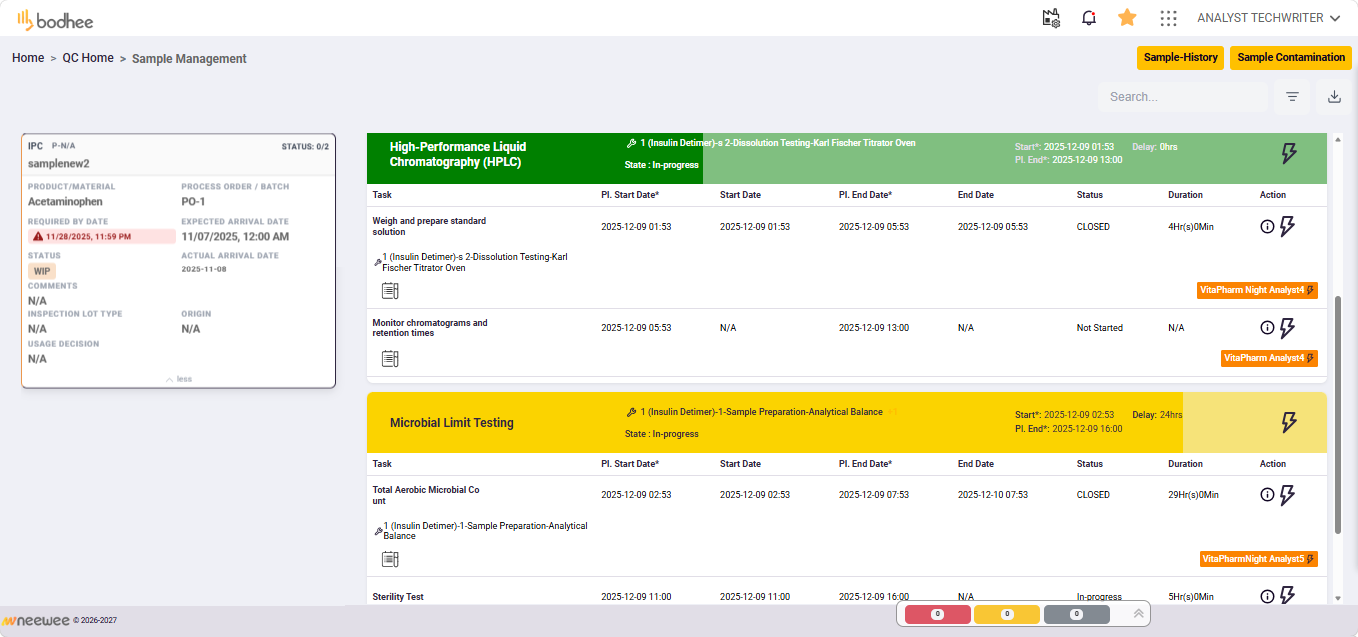
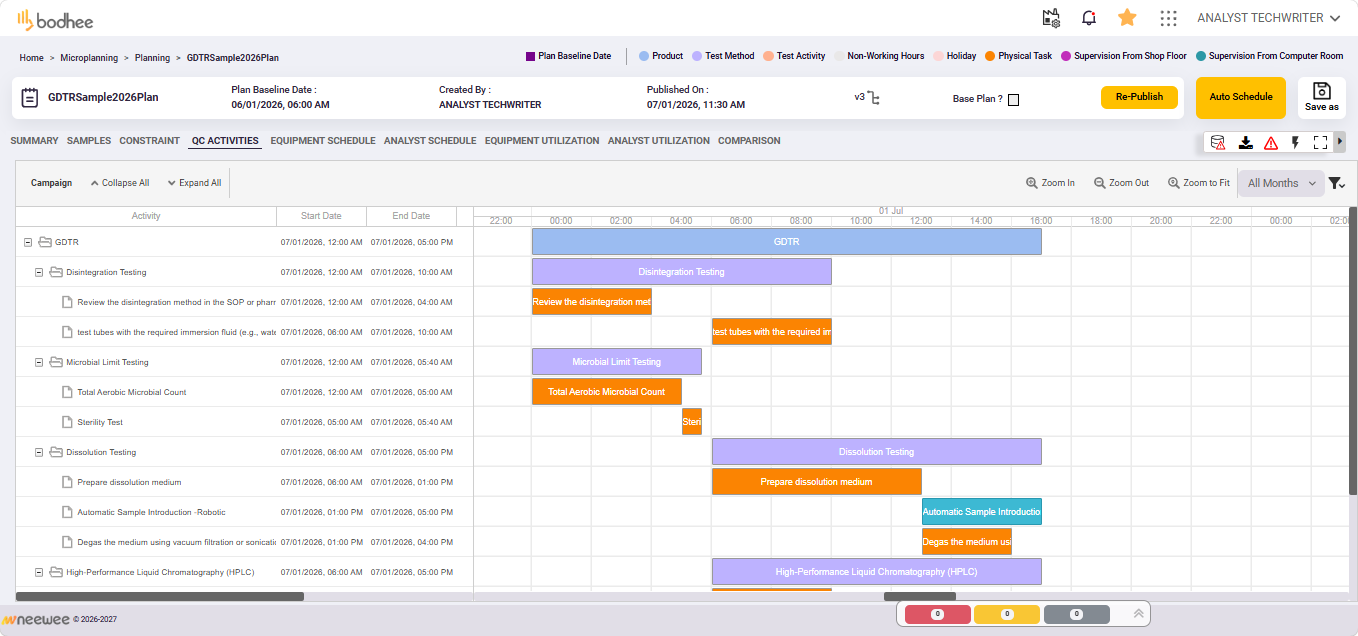
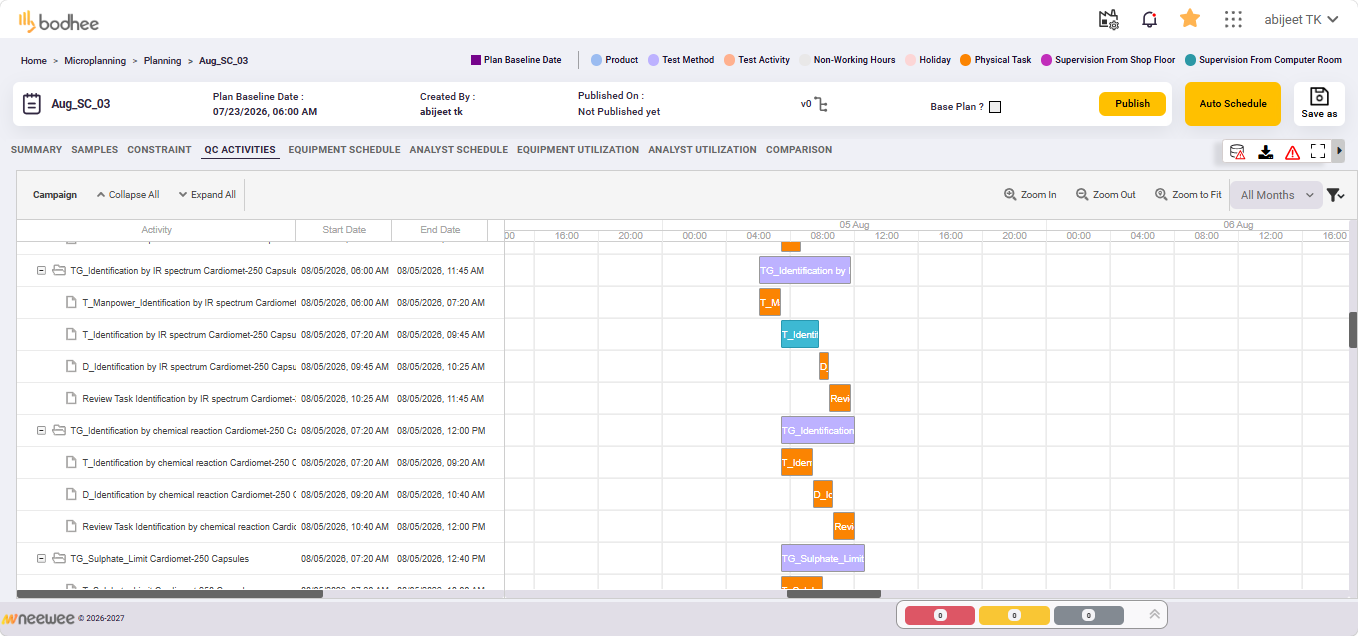
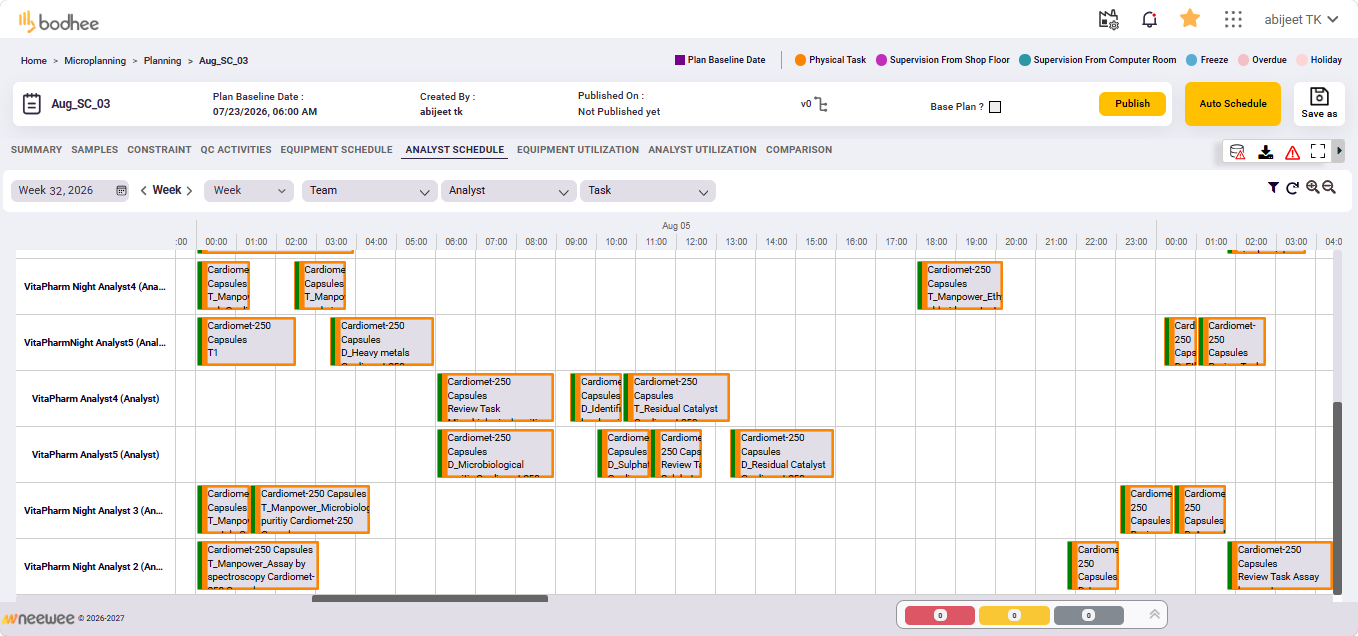
Scroll a single QC sample through Bodhee. These are real Bodhee Quality Control Scheduling screens: the intake board, its test plan, the capacity-aware schedule, and the analyst who runs each test.
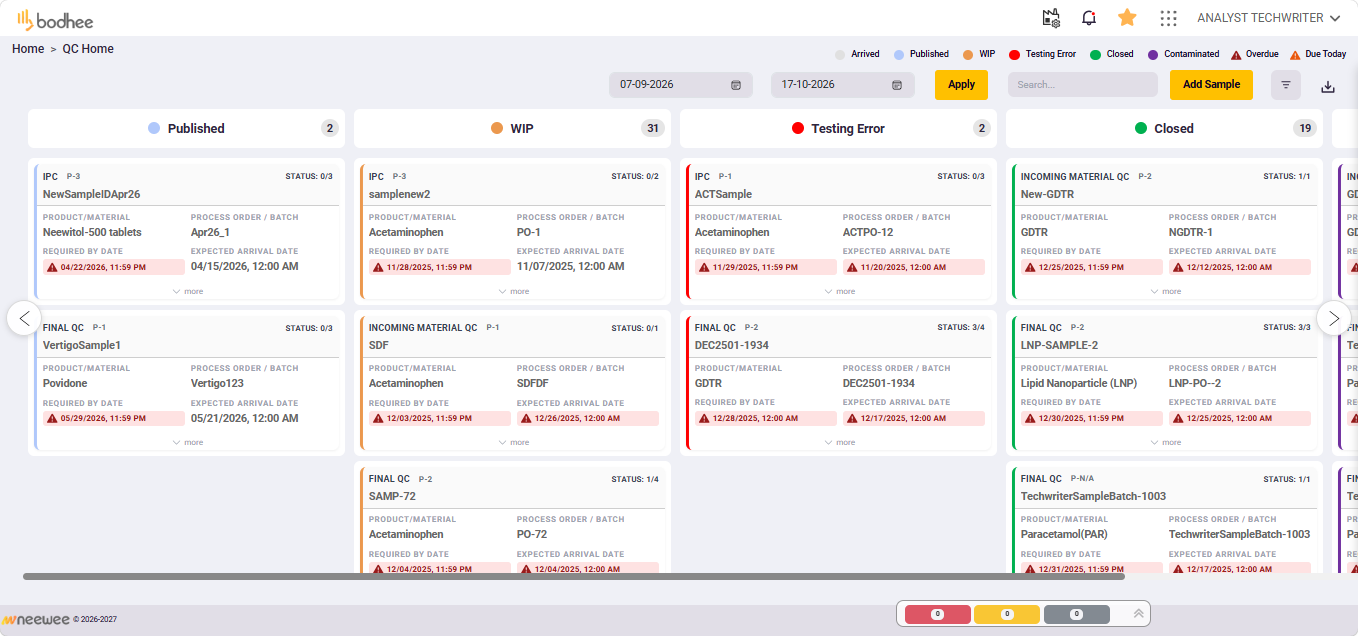
01 · Intake
Every sample on one board
Samples land in QC and move from arrival through work-in-progress to closed, each card carrying its product, batch, arrival and need-by date.
02 · Test plan
Methods and activities per sample
Open a sample to see its scheduled test methods, HPLC, microbial limit, sterility, with every task, its planned and actual times, and the analyst on it.
03 · Schedule
Tests grouped and sequenced
Bodhee groups samples by equipment capacity, arrival and need-by date, then lays every test method and activity onto one timeline.
04 · Activities
Down to the review task
Each method breaks into its steps: manpower, instrument and review tasks, sequenced so dependencies and non-working hours hold.
05 · Analysts
The right analyst, the right bench
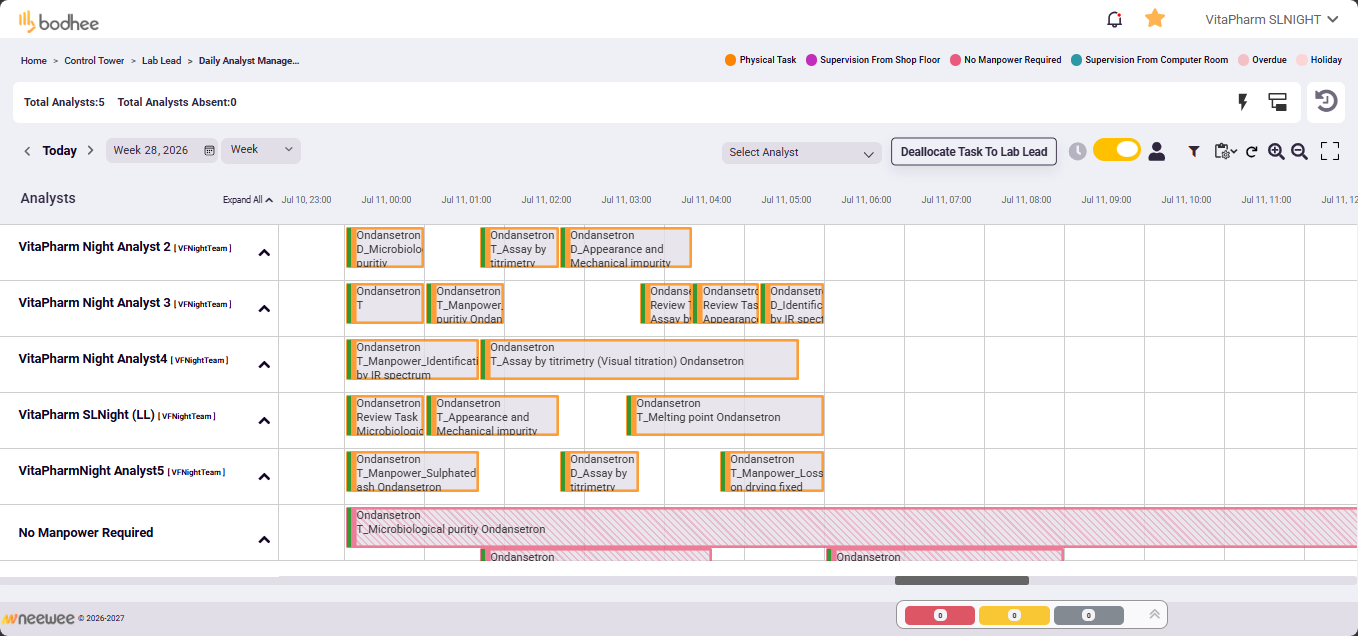
Every activity is allocated to a qualified analyst across the week, balanced against shifts, supervision and instrument availability.
06 · Floor
The lab lead's day, live
The daily view shows each analyst's tasks in real time, with reallocation to the lab lead and overdue and no-manpower flags surfaced on the spot.
Sample logged
Measurable outcomes
What Bodhee QC Scheduling delivers.
Ranges observed across regulated QC deployments. Outcomes vary by lab scale and integration scope.
0–35%
Batch release cycle time
faster release decisions across active lab queues
0–25%
Analyst utilisation
with analyst and instrument constraints honoured together
Hours → Minutes
Reschedule cycle time
after OOS events, rush samples, and queue changes
0%
Method hold-time adherence
for tighter control of time-sensitive samples
−30–50%queue re-sequencing effort
Based on Neewee deployment observations in regulated QC environments.
How it works
Inputs → Engine → Outputs.
Bodhee connects into your existing stack, runs the optimisation, and publishes schedules and events back out.
Inputs · 7
Source systems feeding the engine.
- LIMS
- Chromatography Data System CDS
- MES / Batch events
- Analyst HRMS / LMS
- Instrument calibration
- QMS deviations, OOS
- Bodhee Production events
Engine · 5
Five internal capabilities.
- Sample-method-analyst matching
- Hold-time constraint modelling
- Priority & due-date optimisation
- Event-driven rescheduling
- Batch release forecasting
Outputs · 5
What Bodhee publishes back.
- Daily analyst schedules
- Instrument utilisation plan
- Batch release forecast
- IPC pull-time schedule
- Events → Bodhee Production
Who it's for
Four roles in the QC lab — each with a specific reason.
Primary user
QC Analyst / Supervisor
“I want my day to start with a queue that reflects what's actually waiting — not what we thought was coming when the week started.”
A live queue, re-ranked against today's reality. Hold-time risks surfaced before they become OOS.
Economic buyer
Head of Quality
“I need a batch release forecast I can commit to — and a lab that absorbs disruption without extending cycle time.”
A release forecast that moves in minutes, not days. Cycle time compresses 20–35%.
Operational
QA & Regulatory
“Every deviation from the plan must be explainable and auditable. I don't want AI magic — I want traceable decisions.”
Every scheduling decision traced to its trigger event. Audit trail native, not retrofitted.
Technical buyer
Digital / IT Leaders
“How does this integrate with our LIMS, CDS, and MES — without creating a validation nightmare?”
API-first integration with validated connectors for major LIMS and CDS platforms. GxP-ready.
Customer journey
Three phases to a live lab plan.
1
Assess
Lab maturity assessment. LIMS/CDS landscape review. Sample-type inventory and constraint catalogue.
2
Configure
Analyst skill matrix, instrument capability, method hold-times, integrations with LIMS / CDS / MES / Bodhee Production.
3
Go Live
Parallel run against the existing queue. Calibrate. Cut over by lab area. Ongoing tuning with the QC team.
How Bodhee QC Scheduling is different
Three reasons this isn't a LIMS module.
01
Native integration with upstream production.
The only QC scheduler designed from day one to consume production events as first-class inputs — not a downstream reporting bolt-on.
02
Rebuilt from scratch every cycle.
Constraint programming finds the optimal queue — instead of drag-and-drop repair of yesterday's whiteboard.
03
Built for regulated labs. Not tied to one LIMS.
Deployed against Veeva, LabWare, Thermo SampleManager, Labvantage — without forcing a rip-and-replace.
Frequently asked questions
Questions we hear from QC teams.
A focused subset of the full Bodhee FAQ — answers for the questions QC managers, lab heads, and analysts ask before a pilot.
01
Plans that survive contact with reality. In most process plants, the schedule the planner builds on Monday is broken by Tuesday — a delayed material, a quality hold, an unplanned breakdown, a rush order. Today, planners and supervisors absorb the disruption with phone calls, whiteboards, and overtime. Bodhee replaces that firefighting with a schedule that re-adapts in minutes against the same constraints a human would apply, and shows the planner why.
Yes. Bodhee orchestrates above and below planning. It consumes orders and master data from (typically SAP S/4HANA or ECC, Oracle, or any other ERP), live execution events from MES and historian, quality results from , and asset events from . It then pushes back a feasible, optimised, re-adapting schedule that MES executes and ERP confirms.
02
(Advanced Planning & Scheduling) is built to optimise a plan once — typically weekly — against a snapshot of demand and capacity. is built to re-plan continuously against the live state of the plant. APS answers "what is the best plan for next week?"; Adaptive Scheduling answers "given everything that has changed in the last hour, what is the best plan for the next 24 hours, and which orders are now at risk?"
03
The () is the live representation of your plant that Bodhee reasons against — products, recipes, asset, materials, labour, quality holds, and the constraints that connect them. It is not a 3D model; it is a decision model. Every Bodhee recommendation traces back to a specific state of the PDT, which means every recommendation is explainable.
05
Both, plus the production batches awaiting release. Bodhee Quality Control Scheduling plans sample arrival, test execution, analyst allocation, instrument capacity, and release sequencing for batches blocked by pending results. It treats the lab as a constrained shop floor — because that is what it is.
By pulling three levers at once:
- Priority sequencing — release-blocking and deadline-critical samples are sequenced first.
- Equipment-level optimisation — the sample mix on each instrument is optimised against sample arrival times, required-by dates, and instrument capacity.
- Lab–production coordination — the lab schedule is aligned with the production release plan, so finished batches are not waiting on tests that could have run earlier.
The scheduler knows which finished batches are blocked, by which test, on which instrument, and by which analyst — and sequences accordingly. The visible outcomes are shorter lab turnaround time and fewer batches waiting on release.
Yes — with major vendors including LabWare, STARLIMS, and LabVantage. Bodhee Quality Control Scheduling reads sample registration and test status from the LIMS. Custom LIMS deployments are supported through the standard integration adapter. Writing the test schedule back from Bodhee into LIMS is technically feasible, but the recommended approach is to use Bodhee's data exports / connectivity to integrate into LIMS outside the Bodhee environment.
As constrained queues alongside release testing, with their own priority and pull-date logic. The scheduler respects pull-date windows for stability protocols and ensures regulated tests are not starved by higher-volume release tests.
Yes. Each discipline is modelled as a distinct resource pool with its own instruments, analysts, certifications, and SOPs. A single deployment can manage a microbiology lab, a chemistry lab, and a physical-testing lab on different floors or sites under one schedule.
Customer outcomes show consistent reductions in sample backlog and lab turnaround time. Named results are published in the case-study library. Reference customers are made available after qualification stage.
Yes. The scheduler schedules around analyst skill, certification, shift, and current workload. Senior analysts are not over-allocated to routine work, and certifications are honoured automatically. Using the Bodhee side-task functionality, the lab can keep a buffer of pre-planned work (for example, a daily 9 AM status call or ad-hoc training for an analyst) ready to slot into analyst downtime without needing a new approval or re-prioritisation.
07
No. systems plan at weekly / monthly cadence against forecast and capacity assumptions. Bodhee adapts at daily / shift cadence against live plant state. They are complementary: APS sets the boundary conditions and the production targets; Bodhee adapts the schedule inside those boundaries as the plant runs.
09
Bodhee is a product, deployed on Google Cloud Platform () and operated by Neewee. Customers do not host, install, or operate the product themselves. Bodhee is not offered for installation on customer-managed infrastructure or inside a customer's own cloud account.
The SaaS model is deliberate: continuous releases, managed security operations, observability, and incident response all stay inside one team that understands the product end-to-end — which is materially safer and faster than a fleet of customer-managed installs. Data residency is configurable across GCP regions (see Q 9.3), each customer runs in a single-tenant data plane, and customer-managed encryption keys are available for customers who require key isolation (see cluster 11 for the full security and compliance posture).
10
Yes — through productised connectors for the most common SAP scenarios (S/4HANA, ECC, PP, PM, QM, MM) and a custom integration path for non-standard configurations. SAP integrations follow a documented data-flow pattern (orders + master data in; schedule + confirmations out). We capture process orders, material master, inventory data, factory and holiday calendars, BOMs, goods receipts (for QC scheduling against raw materials), recipes (where available), equipment and resource master data, and shift-level crew data. Data connectivity uses REST, SOAP, Pub/Sub, or file import / export.
Bodhee Quality Control Scheduling is -vendor-agnostic by design. Data exchange uses the integration pattern the customer's LIMS already supports — REST, SOAP, file import / export, or direct database read — through Bodhee-managed connectors. The scheduler reads sample registration and test status from the LIMS (and for raw-material goods receipts).
11
Bodhee is operated under an information-security programme aligned to . Customers under can request the latest ISO 27001 certificate.
12
First measurable value usually lands in weeks; full module rollout typically lands in months. Exact timeline depends on data readiness, integration scope, and the number of sites in scope. A typical pattern is pilot in 12 weeks, full single-site rollout in 20 weeks, multi-site expansion thereafter.
14
Pricing combines a per-site, per-module licence with a usage component sized to plant scope (assets, lines, lab benches, work-order volume). The exact model is shaped to the customer's deployment topology — we walk through it in detail during evaluation.
15
Outcome bands depend on the module, the starting state of the operation, and the scope of deployment. Typical published outcomes range from low-double-digit improvements in adherence or throughput at well-run sites, to step-change improvements (30 %+) at sites where manual scheduling has been the bottleneck. The honest answer for any specific customer comes out of a baseline assessment during evaluation.
Release faster. Without shortening the science.
A 30-minute tour of Bodhee QC Scheduling — the engine, the upstream integration, and how it fits your lab.