
Bodhee is the product family for process manufacturing. Three coordinated schedulers — Bodhee Production Scheduling, Bodhee Quality Control Scheduling, and Bodhee Maintenance Scheduling — work against a live () of your plant. Where a traditional plan is set weekly and re-worked manually, Bodhee re-plans continuously as orders, materials, assets, quality results, and labour change in the real world.
Bodhee Production Scheduling
From Rigid Schedules
to Resilient Operations.
When a batch extends, a reactor trips, or QC clears a hold, Bodhee Production Scheduling rebuilds the plant's schedule in minutes — against every live constraint. Built for pharmaceuticals, specialty chemicals, and process industries.
Built for batch and continuous process plants. Rebuilds schedules in minutes against live constraints.
Industry context
The gap between world-class and typical is wider than most plants admit.
85%
World-class OEE target
Nakajima / TPM benchmark
35–65%
Typical OEE in regulated process manufacturing
Industry-reported
30%+
Staffed time lost to cleaning, changeover, validation
~60% of availability losses
10–15%
Capacity lost to cross-functional scheduling misalignment
Directional
Figures are directional industry benchmarks — not Neewee customer outcomes. Source attributions: SCW.ai, TEEPTRAK, Fortune Business Insights.
The problem
Why production scheduling is broken in process manufacturing.
Legacy APS tools miss five structural realities of the plant. Each one creates avoidable instability, wasted capacity, and extra planner effort.
01
No response to live factory-floor data
Schedules become static the moment they're published. The floor moves. The schedule doesn't.
02
Cannot manage the full constraint universe
Process, equipment, materials, workforce, maintenance, quality — interacting non-linearly. Not modelled.
03
Rigid master data, no personalisation
Line A and Line B forced into the same model even when they operate differently.
04
Invisible indirect activities
Cleaning, changeover, QC, documentation consume 30%+ of time but aren't in the schedule.
05
Static plans in a dynamic plant
Production, QC, and Maintenance plan independently on schedules that can't replan, so conflicts surface late and teams spend time reconciling plans instead of executing them.
Meet Bodhee Production Scheduling
An enterprise SaaS product for production scheduling in process manufacturing.
Three techniques, one engine.
Bodhee combines constraint programming, multi-objective optimisation, and AI agents for event management — in a single engine designed for how process plants actually run.
Industry-agnostic, industry-proven.
Deployed in pharmaceuticals, specialty chemicals, and process industries. The engine is industry-agnostic; the configuration is plant-specific.
Three fundamental problems solved.
Optimised Schedule Generation. Agentic Rescheduling. Cross-Functional Schedule Synchronisation.
The five pillars
What Bodhee Production Scheduling does.
Pillar 01
Control & Manage Production Events
See every event in real time.
- IT/OT connectivity — ERP, MES, QMS, LIMS, SCADA
- End-to-end floor visibility
- Unified event registry
Pillar 02
Master Data with Visual Interface
Your plant, modelled the way it actually runs.
- Line-level personalisation
- Planner-editable — no IT required
- Continuous accuracy improvement
Pillar 03
Optimised Schedule Generation
Schedules that actually execute.
- Full constraint universe honoured
- Dynamic bottleneck management
- Minute-level granularity
Pillar 04
Agentic Rescheduling
Rescheduling in minutes, not hours.
- Event-driven agents
- Actionable recommendations
- Conflict resolution with feedback loop
Pillar 05
Cross-Functional Integration Layer
One plant. One live schedule.
- Event propagation across functions
- Cross-functional impact assessment
- Configurable response modes
See it in action
One event, across the whole schedule
Scroll through a single disruption as Bodhee re-solves it. These are real Bodhee Production Scheduling screens: the plan, the event, the re-solve, the explanation, and the rebalance.
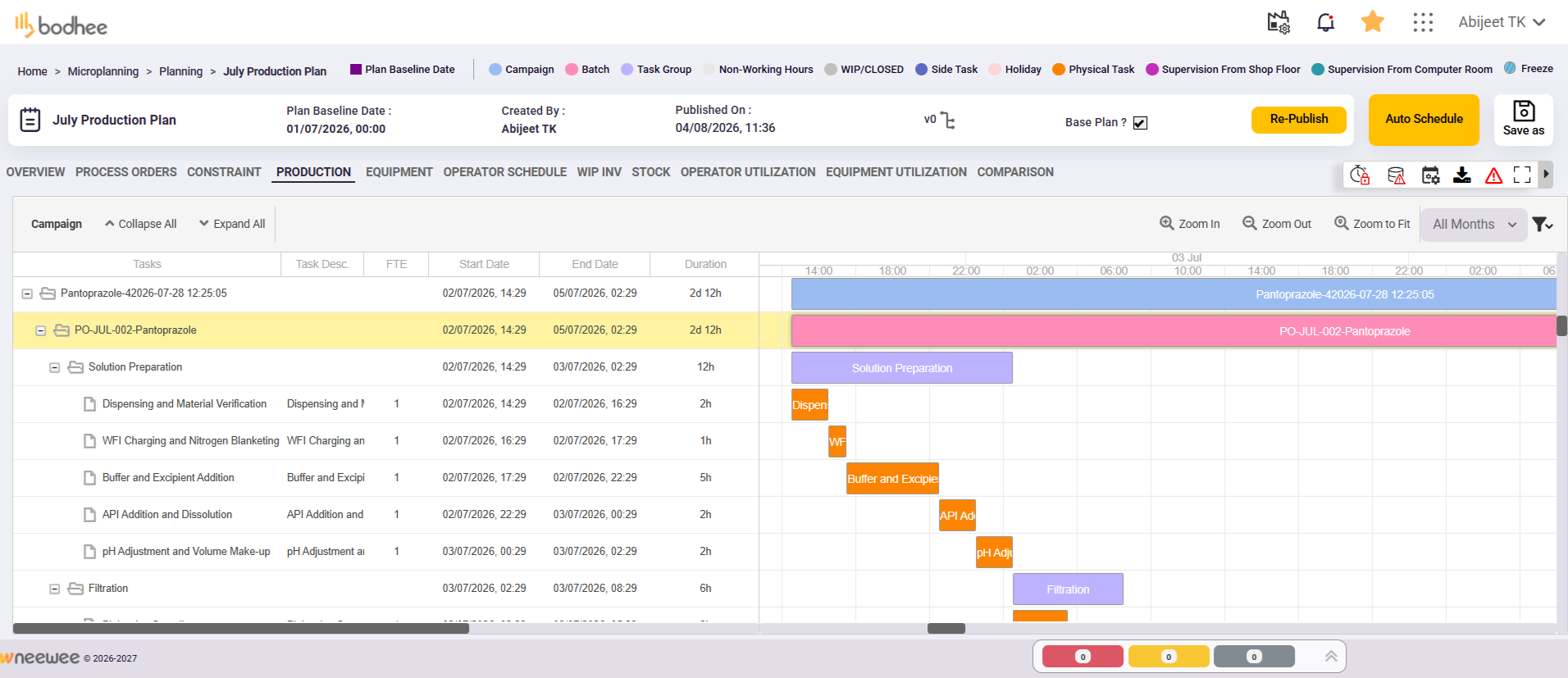
01 · Plan
The published plan
Campaign, batch, and task on one Gantt. Feasible and frozen at 07:00, before the shift touches it.
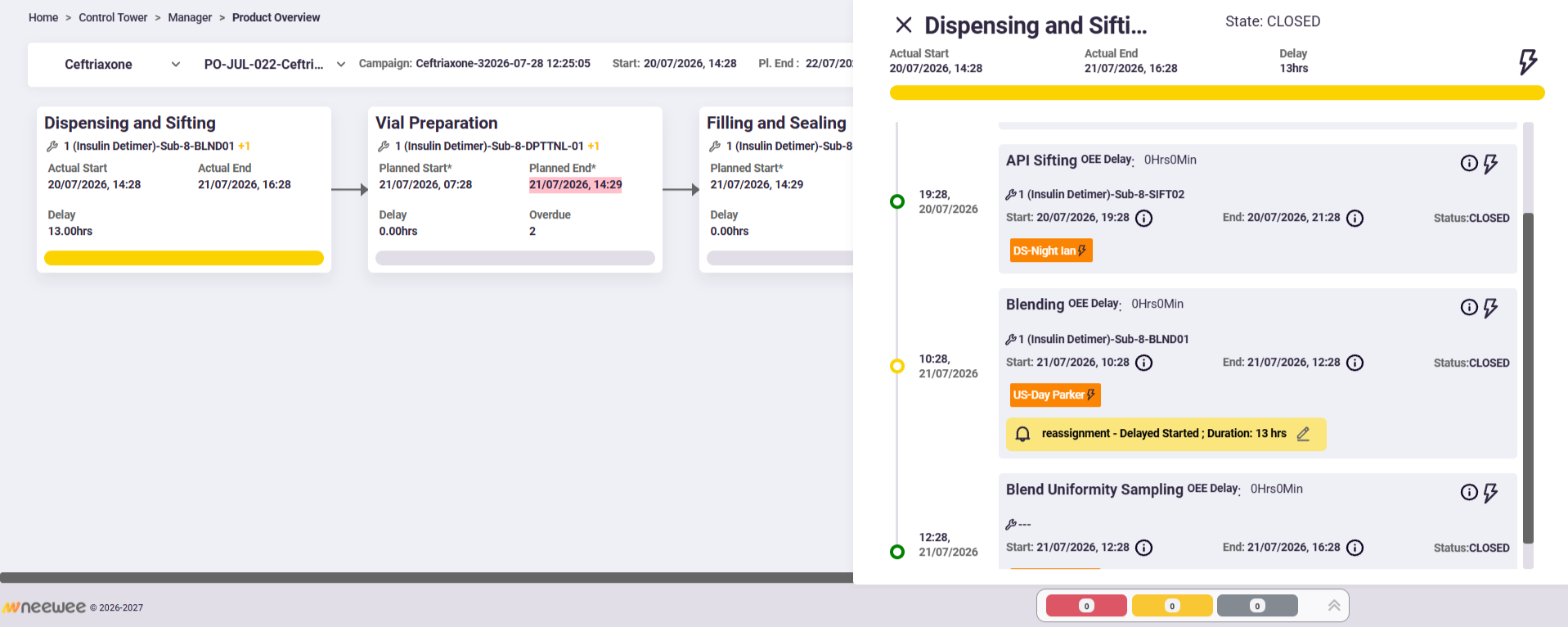
02 · Event
A step slips
Blending runs thirteen hours long. Bodhee registers it the moment it happens on the floor.
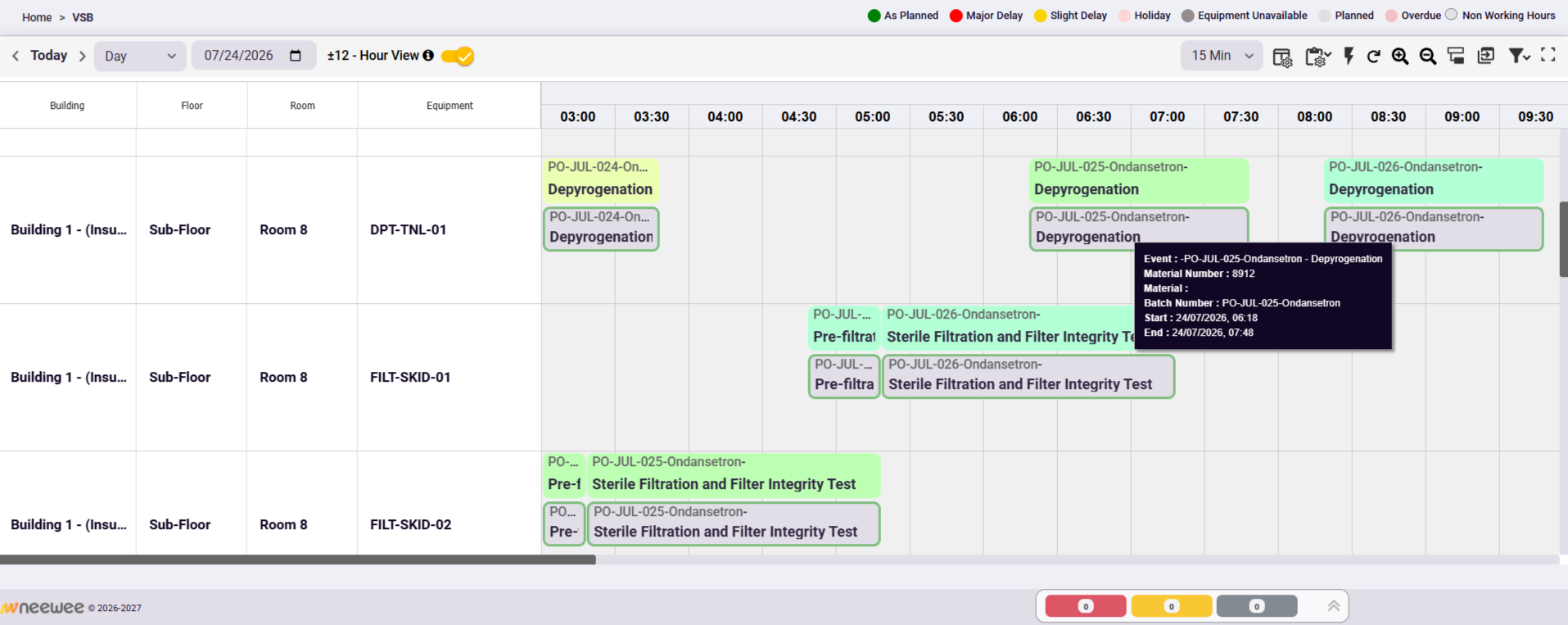
03 · Re-solve
The board re-solves
Downstream tasks reschedule against equipment, material, and shift constraints, in minutes.
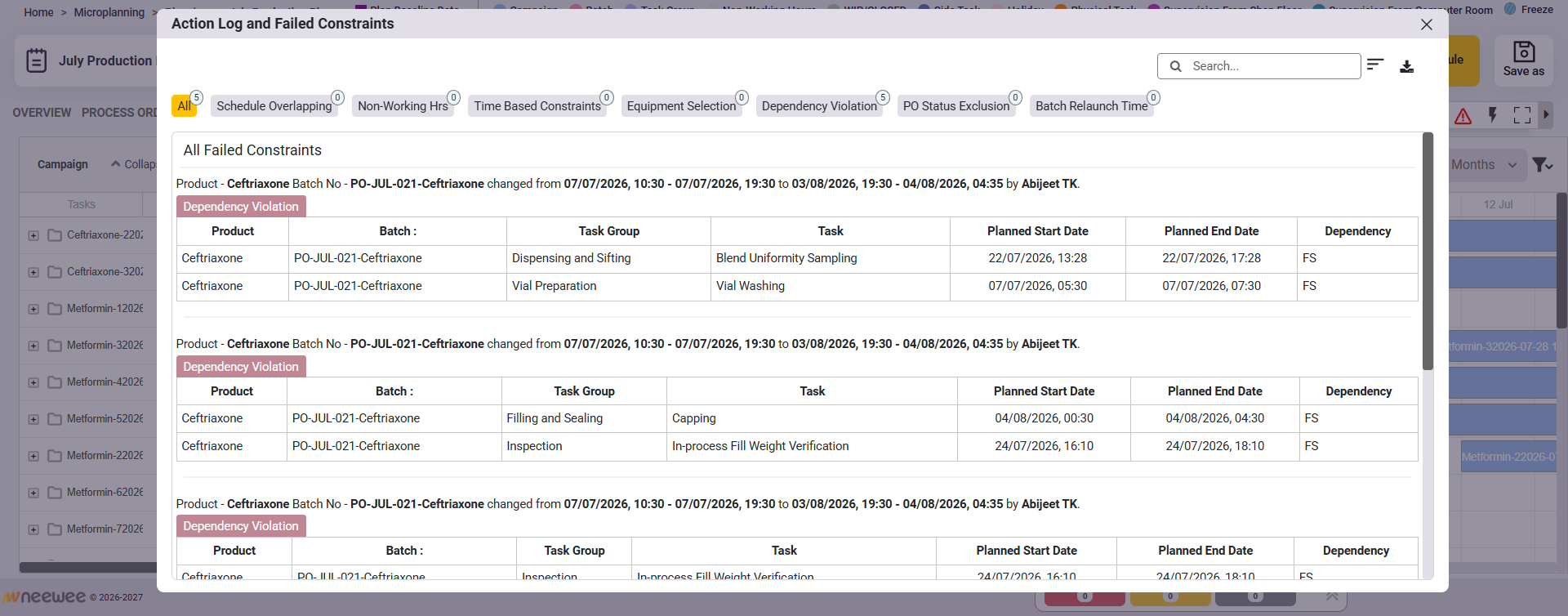
04 · Explain
Every change, accountable
The constraints a change would break are listed before it commits, each against the tasks it touches.
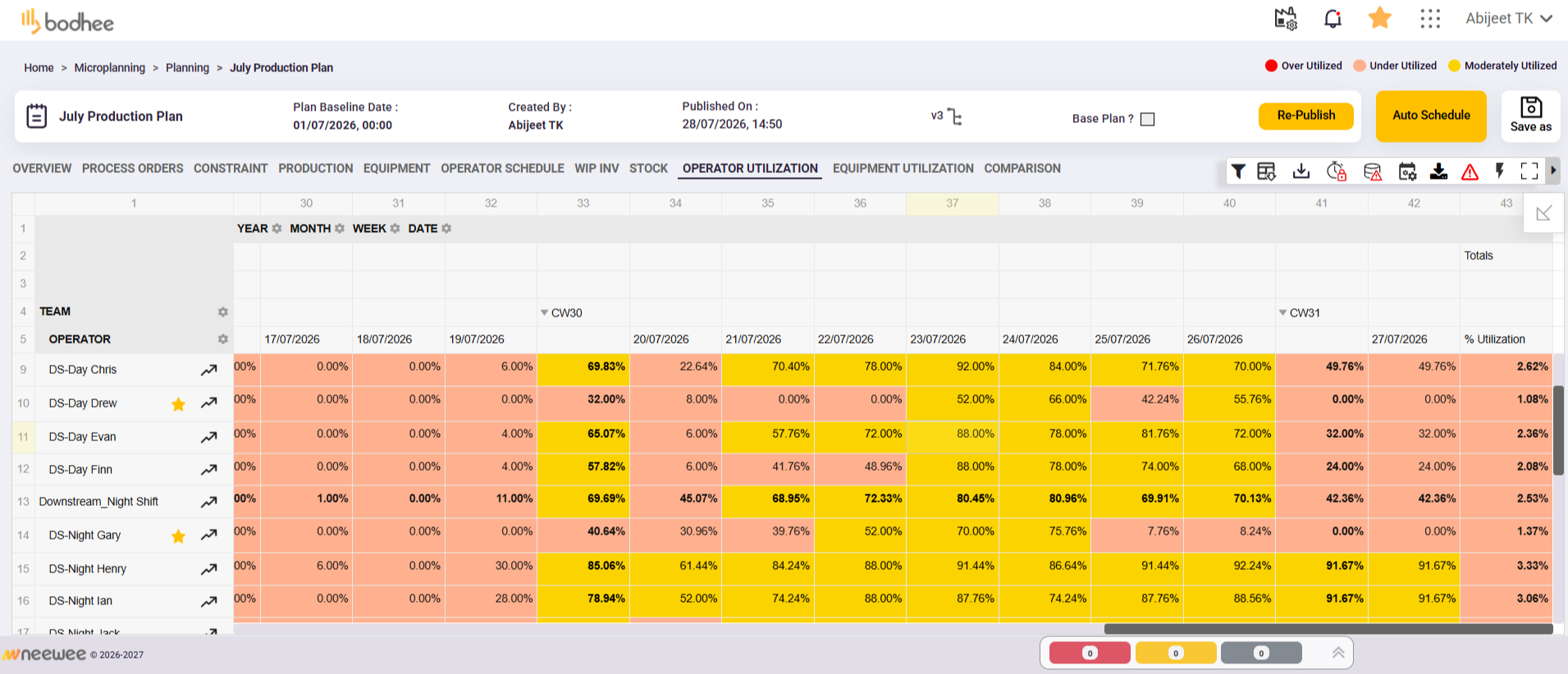
05 · Rebalance
Load rebalanced
Operator and equipment utilisation update with the new plan, so no one is quietly over-committed.
Planned
Measurable outcomes
What Bodhee Production Scheduling delivers.
Ranges observed across process manufacturing deployments. Outcomes vary by plant complexity, data maturity, and integration scope.
0–15 pp
OEE improvement
across regulated process manufacturing deployments
0–15%
Cross-functional capacity recovery
from synchronised production, QC, and maintenance planning
0–20%
WIP inventory
through tighter schedule execution and less waiting
0–25%
On-time delivery
from more reliable schedule execution
−60–80%planner scheduling effortHours → Minutesrescheduling cycle time+15–25%changeover efficiency
Based on Neewee deployment observations in regulated process manufacturing.
How it works
Inputs → Engine → Outputs.
Bodhee connects into your existing stack, runs the optimisation, and publishes schedules and events back out.
Inputs · 7
Seven source-system classes feed the engine.
- ERPSAP, Oracle
- MES
- EAM / CMMS
- HRMS
- LMS / Training
- QMS / LIMS
- SCADA / Historian
Engine · 5
Five internal capabilities, one engine.
- Constraint Modelling
- Multi-Objective Optimisation
- Real-Time Event Processing
- Cross-Functional Event Propagation
- Simulation & What-If Analysis
Outputs · 5
What Bodhee publishes back.
- Minute-Level Production Schedule
- Rescheduled Plans
- Capacity & Bottleneck Reports
- Agent-Driven Recommendations
- KPI Dashboards
Who it's for
Four roles. Four different reasons Bodhee earns its place.
Primary user
Production Planner / Scheduler
“I need to understand the impact of disruptions on the overall schedule, simulate alternatives, identify bottlenecks, and test process changes before committing them.”
Scheduling effort drops 60–80%. Simulation replaces the overnight rebuild. Every recommendation is explainable.
End users
Operators & Supervisors
“When something goes wrong on my shift, I need to know immediately: what do I do next, and can we still meet today's targets?”
A live schedule on the floor — not a paper plan from yesterday morning. Event visibility within seconds.
Economic buyer
Plant Manager / Unit Head
“Am I utilising my plant capacity optimally? Despite disruptions, how do I achieve my business goals effectively?”
OEE improves 10–15 pp. Cross-functional capacity recovers by 10–15%. Defensible commitments to the business.
Technical buyer
Digital / IT Leaders
“How does this fit into our existing IT landscape? Will it integrate cleanly, scale across sites, and meet our data-governance requirements?”
API-first, cloud-native, with enterprise-grade integrations for regulated manufacturing environments.
Customer journey
Three phases to production.
1
Assess
Maturity assessment and deployment roadmap. What's in place, what needs building, where Bodhee plugs in.
2
Configure
Plant-specific configuration — master data enrichment, constraint modelling, integrations with ERP/MES/QMS/LIMS/SCADA.
3
Go Live
Parallel run. Iterative rollout. Model calibration. Ongoing improvement with the planning team.
How Bodhee is different
Three reasons this isn't the APS tool you've seen before.
01
Cross-functional integration as a first-class capability.
The only scheduling system where an event in Production, QC, or Maintenance triggers synchronised rescheduling across all three — automatically.
02
Agentic rescheduling, not static rules.
Agents watch the floor, classify events, and invoke the scheduling engine within minutes, instead of waiting for planners to rebuild the schedule by hand.
03
Purpose-built for process manufacturing.
Constraint programming and multi-objective optimisation designed for batch and continuous process plants — not adapted from discrete-manufacturing paradigms.
Frequently asked questions
Questions we hear from production teams.
A focused subset of the full Bodhee FAQ — answers for the questions production planners, plant managers, and ops leaders ask before a pilot.
01
Plans that survive contact with reality. In most process plants, the schedule the planner builds on Monday is broken by Tuesday — a delayed material, a quality hold, an unplanned breakdown, a rush order. Today, planners and supervisors absorb the disruption with phone calls, whiteboards, and overtime. Bodhee replaces that firefighting with a schedule that re-adapts in minutes against the same constraints a human would apply, and shows the planner why.
Yes. Bodhee orchestrates above and below planning. It consumes orders and master data from (typically SAP S/4HANA or ECC, Oracle, or any other ERP), live execution events from MES and historian, quality results from , and asset events from . It then pushes back a feasible, optimised, re-adapting schedule that MES executes and ERP confirms.
02
(Advanced Planning & Scheduling) is built to optimise a plan once — typically weekly — against a snapshot of demand and capacity. is built to re-plan continuously against the live state of the plant. APS answers "what is the best plan for next week?"; Adaptive Scheduling answers "given everything that has changed in the last hour, what is the best plan for the next 24 hours, and which orders are now at risk?"
03
The () is the live representation of your plant that Bodhee reasons against — products, recipes, asset, materials, labour, quality holds, and the constraints that connect them. It is not a 3D model; it is a decision model. Every Bodhee recommendation traces back to a specific state of the PDT, which means every recommendation is explainable.
04
Bodhee Production Scheduling generates and continuously adapts a feasible, optimised production schedule against live constraints — orders, recipes, asset availability, materials, labour, and priority. When any of those change, the schedule re-plans within minutes with a goal to minimise the impact of that change on the schedule and the plant performance.
Demand / order data (campaigns, process orders, planned orders), products & recipes, assets, raw-material and intermediate availability, teams and operators and their skills, changeover and cleaning rules, and calendars (factory, shift, holiday). Most of these already exist in your , , and master-data systems — Bodhee Production Scheduling reads them through standard connectors and the layer.
All three, and the mixes of them that real plants run. Bodhee Production Scheduling treats each line on its own terms:
- Campaign-mode lines — orders are grouped and sequenced so similar products run back-to-back, amortising changeover and cleaning across the campaign and minimising cross-contamination risk.
- Batch-mode lines — orders are scheduled batch-by-batch against recipe, asset compatibility, and batch duration, with cleaning, validation, and hold-time windows respected between batches.
- Continuous-mode lines — production is scheduled as a throughput rate against asset constraints, run-length limits, and the upstream / downstream lines that feed or are fed by the continuous train.
A single plant can run all three side by side — the scheduler does not force one model onto every line. Where one mode's output feeds another (e.g., a continuous reactor feeding a batch crystalliser feeding a packaging campaign), Bodhee schedules the handoffs as constraints rather than treating each line in isolation.
Cleaning is modelled as a schedulable process in its own right — with its own tasks, durations, resources, and dependencies — not as a fixed overhead bolted onto production. Cleaning tasks link to production batches through the trigger patterns that real plants actually run on:
- Pre-production — cleaning before the first batch or campaign starts.
- Post-batch / post-campaign — cleaning at the end of a batch or at the end of a campaign.
- Mid-batch — cleaning triggered after a specific task inside a batch completes.
- Production-blocked-on-cleaning — a production task that cannot start until a specified cleaning process is complete.
Changeovers follow the same model — typed by product-pair, costed, and sequenced by recipe family — and validation holds (post-cleaning verification, pre-processing steps) are modelled as their own gated task class with their own duration and downstream blocking effect. Bodhee Production Scheduling respects every cleaning, changeover, and validation rule, and sequences orders to minimise their cumulative cost when the order book allows.
Yes — overrides are first-class, not exceptions. A planner can fix or freeze an order, lock an equipment to an order, exclude an asset, exclude a set of operators, set priority on certain materials, or force a window; the scheduler adapts the rest of the plan around the override.
Minutes for typical single-plant scope; configurable for larger horizons and multi-site scope. Re-plan cadence is event-driven by default — the system triggers when a constraint materially changes, not on a fixed clock. Typically granular rescheduling (with operator re-allocation) runs for the next 24–48 hours, and strategic re-planning runs for the next 2–4 weeks, depending on the level of disruption and the user-configured cadence.
Both. The default is a single recommended plan, ready to dispatch. The planner can also run what-if scenarios — "what if we lose Line 2 for six hours", "what if we accept the rush order", "what if we push the changeover to night shift" — and compare KPI impact side-by-side before committing.
Yes. The scheduler consumes material status from and , detects shortages or late arrivals against the planned sequence, and re-sequences orders to absorb the disruption rather than break the plan. Where re-sequencing is not enough, it surfaces the risk early with the trade-offs spelled out. Material availability data from ERP is enriched using the active schedule for forecasted material availability (e.g., semi-finished-goods availability for finished goods).
Yes. Multi-site deployments are supported with site-level autonomy as the default — each plant runs its own schedule with its own constraints — and cross-site orchestration where the order book genuinely flows between sites. Bodhee supports both topologies.
07
No. systems plan at weekly / monthly cadence against forecast and capacity assumptions. Bodhee adapts at daily / shift cadence against live plant state. They are complementary: APS sets the boundary conditions and the production targets; Bodhee adapts the schedule inside those boundaries as the plant runs.
No. executes and records work on the shop floor; Bodhee schedules what the MES will execute. Most deployments leave MES untouched and integrate Bodhee above it.
09
Bodhee is a product, deployed on Google Cloud Platform () and operated by Neewee. Customers do not host, install, or operate the product themselves. Bodhee is not offered for installation on customer-managed infrastructure or inside a customer's own cloud account.
The SaaS model is deliberate: continuous releases, managed security operations, observability, and incident response all stay inside one team that understands the product end-to-end — which is materially safer and faster than a fleet of customer-managed installs. Data residency is configurable across GCP regions (see Q 9.3), each customer runs in a single-tenant data plane, and customer-managed encryption keys are available for customers who require key isolation (see cluster 11 for the full security and compliance posture).
10
Yes — through productised connectors for the most common SAP scenarios (S/4HANA, ECC, PP, PM, QM, MM) and a custom integration path for non-standard configurations. SAP integrations follow a documented data-flow pattern (orders + master data in; schedule + confirmations out). We capture process orders, material master, inventory data, factory and holiday calendars, BOMs, goods receipts (for QC scheduling against raw materials), recipes (where available), equipment and resource master data, and shift-level crew data. Data connectivity uses REST, SOAP, Pub/Sub, or file import / export.
Bodhee is -vendor-agnostic by design. Data exchange with the MES uses the integration pattern the customer's MES already supports — REST, SOAP, MQTT, Pub/Sub messaging, , file import / export, or direct database read — through Bodhee-managed connectors. There is no Bodhee-specific protocol the MES must speak.
For non-standard or custom MES, the connector is built during the integration phase against the documented integration contract.
11
Bodhee is operated under an information-security programme aligned to . Customers under can request the latest ISO 27001 certificate.
12
First measurable value usually lands in weeks; full module rollout typically lands in months. Exact timeline depends on data readiness, integration scope, and the number of sites in scope. A typical pattern is pilot in 12 weeks, full single-site rollout in 20 weeks, multi-site expansion thereafter.
14
Pricing combines a per-site, per-module licence with a usage component sized to plant scope (assets, lines, lab benches, work-order volume). The exact model is shaped to the customer's deployment topology — we walk through it in detail during evaluation.
15
Outcome bands depend on the module, the starting state of the operation, and the scope of deployment. Typical published outcomes range from low-double-digit improvements in adherence or throughput at well-run sites, to step-change improvements (30 %+) at sites where manual scheduling has been the bottleneck. The honest answer for any specific customer comes out of a baseline assessment during evaluation.
Ready to bring your plant onto a single schedule?
A 30-minute tour of Bodhee Production Scheduling — the engine, the cross-functional layer, and how it fits your plant.