
Scheduling cleaning and changeovers in pharma plants
Changeovers decide whether a pharma plan holds. Why cleaning time is a matrix, not a number; how hold times and shared cleaning resources break static plans; and how sequencing recovers capacity without new equipment.
 26 Oct 202613 min read
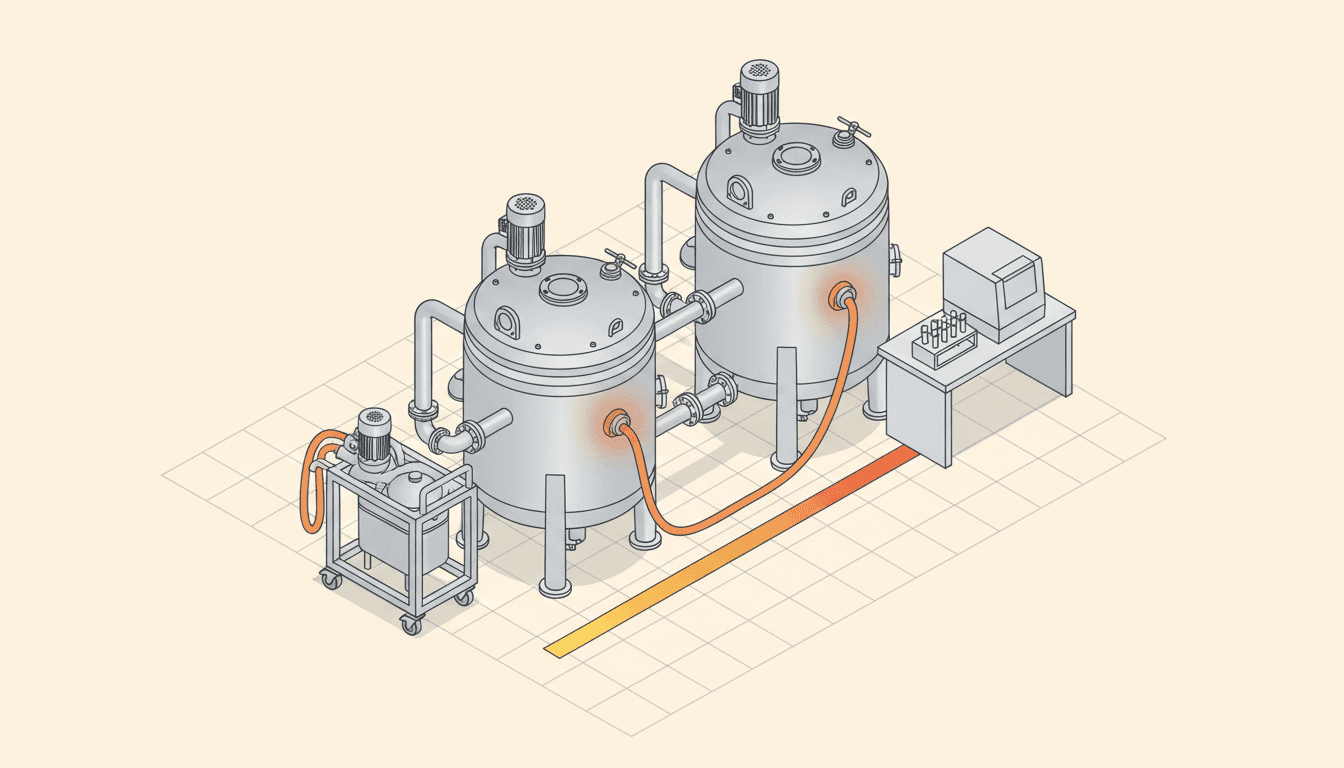
Every pharma planner knows the plan on the whiteboard is rarely the plan that runs. A big reason is the time between one batch and the next: cleaning, verification, changeover. On shared equipment, that gap decides whether the rest of the plan holds.
Most scheduling conversations focus on batch durations and due dates. Cleaning and changeovers get a flat allowance and are treated as dead time. In a regulated plant, that's a costly simplification. Changeovers eat capacity, carry compliance rules, and change with every product pair you run.
How much capacity? Industry estimates put cleaning, changeover, validation and QC hold at roughly a third of staffed time in regulated process plants. That's a directional figure, not a measurement of your site, but most planners who check their own week find it uncomfortably close. We looked at where that time goes in the 30% problem. This post is about the part a schedule can actually change.
Why changeovers are the hidden lever
Batch durations are mostly fixed. The reaction takes as long as it takes; the dryer cycle is validated. You can't schedule your way to a faster batch.
Changeovers are different. How many you run, which product follows which, and when the cleaning crew and skid are free are all scheduling decisions. Two plans that make exactly the same batches in the same week can differ by a full day or more of cleaning time, purely because of the order the products run in.
That makes changeovers the one big block of non-productive time that planning can reduce without touching the process, the equipment or the validation.
A changeover is a compliance event, not just lost time
In a multi-product pharma or API plant, the cleaning required between two batches depends on what ran before and what runs next. The same vessel can need a quick rinse for one pair of products and a full validated clean for another.
Four things drive that.
Cleaning level
Consecutive batches of the same product in a campaign often need only a minor clean. Switching products, or moving from a potent compound to a general one, triggers a full clean, often followed by swab sampling and a QA release before the equipment can be used again.
Cleaning validation limits
Carryover limits such as MACO (maximum allowable carryover), and the cleaning validation matrix built on them, define which product transitions are permitted on which equipment, and with which validated cleaning procedure. Some transitions simply aren't allowed on some equipment. A schedule that proposes one isn't a tight plan; it's an infeasible one.
Hold times
Equipment has a dirty hold time (how long it can sit uncleaned after use) and a clean hold time (how long it stays "clean" before it must be cleaned again). Both are validated limits. If a vessel sits dirty or clean past its limit, it needs re-cleaning before use. That turns every delay into a possible extra clean.
Shared cleaning resources
Cleaning crews, CIP/SIP skids, QA release of a cleaned line, and the lab's capacity to test swab and rinse samples are all limited, and they're often shared across lines or buildings. On a busy week, the bottleneck isn't the reactor. It's the one CIP skid that three vessels need on the same afternoon, or the swab results waiting in a lab queue.
The result is that changeover duration is not one number. It's a matrix, and the schedule you build should respect it.
What a changeover matrix looks like
Here's a simplified example for four products sharing one train. Product A and B are low-potency and from the same family; C is medium-potency; D is a high-potency compound. Hours include cleaning, verification and release. The numbers are a composite for illustration, not any specific plant.
| From \ To | A | B | C | D |
|---|---|---|---|---|
| A | 2 | 6 | 12 | 12 |
| B | 6 | 2 | 12 | 12 |
| C | 24 | 24 | 2 | 12 |
| D | 30 | 30 | 30 | 2 |
A few patterns are typical:
- The diagonal is cheap. Running the same product again needs only a minor clean.
- Same-family moves are moderate. A to B and back costs hours, not days.
- Going up in potency is cheaper than coming down. Moving from a low-potency product to a high-potency one carries less carryover risk, so the clean is shorter. Coming back down from D needs the full validated clean, swabs and release.
- The matrix isn't symmetric. A to D is 12 hours; D to A is 30. Any scheduler that stores "changeover time between A and D" as one number is wrong in one direction.
Real matrices are larger, depend on the specific equipment, and come from QA's validated cleaning procedures. But even this small one shows why an average changeover time can't produce a plan that holds.
Where static schedulers break down
Spreadsheets and rule-of-thumb schedulers cope when a plant runs one or two products. They struggle once several products share equipment. Three failure patterns show up again and again.
Flat changeover allowances
Using one average duration for every transition pads some slots and squeezes others. Across the product changes in the matrix above, the average is about 17 hours. Plan every product change at 17 hours and each A-to-B changeover carries 11 hours of padding, while every D-to-A changeover overruns by 13. The plan looks feasible on paper and slips on the floor.
Cleaning treated as an afterthought
If cleaning isn't scheduled as a task with its own crew, equipment and hold-time limits, conflicts only appear when the shift starts. Two vessels finish at 14:00, both need the CIP skid, and nobody planned the second one to wait. One of them now sits dirty, its dirty-hold clock running.
Plans that go stale
A late raw material, a failed QC test or an equipment fault moves one batch. Every downstream changeover then changes, but a static plan doesn't know that.
Here's how one slip cascades. A vessel is cleaned on Monday at 22:00, with a 72-hour clean hold time, so the clean is valid until Thursday at 22:00. The next batch is planned for Wednesday. A raw material arrives late and the batch moves to Thursday at 14:00: still inside the hold, so nothing looks wrong. Then a second, smaller delay pushes the start to Friday at 06:00. The clean has lapsed. The vessel needs re-cleaning, which needs the CIP skid, which is booked for another line, which now slips too.
Each step is small and every rule is reasonable. A planner tracking it by hand spends the day re-sequencing and still misses one. (We've written before about why the schedule is already wrong by 9 a.m. in most process plants; changeovers are where that shows up first.)
The cost isn't only lost hours. It's idle shifts nobody planned, rushed cleans, and deviations that begin as a scheduling shortcut.
Sequencing: where the capacity comes back
Because the matrix isn't symmetric, the order of a campaign matters as much as its contents.
Take the four products above, each run once per weekly cycle.
Sequence 1, by due date: D, A, C, B, then back to D next cycle. The transitions are D→A (30), A→C (12), C→B (24) and B→D (12): 78 hours of changeover per cycle.
Sequence 2, grouped and ordered by potency: A, B, C, D, then back to A. The transitions are A→B (6), B→C (12), C→D (12) and D→A (30): 60 hours per cycle.
Same products, same batches, same equipment. Sequence 2 frees 18 hours every cycle, more than two shifts, and runs one fewer full validated clean.
That doesn't mean sequence 2 is always right. If Product D is due Tuesday, sequence 1 may be the only way to hit the date. The point isn't that one rule always wins. It's that the planner should see what each sequence costs, in hours and in full cleans, before choosing. A flat allowance hides that choice entirely.
Two further sequencing levers are worth knowing:
- Campaign length. Running more consecutive batches of one product spreads one full clean over more output. It also makes every other product wait longer, so the right length is a trade-off between changeover cost and due-date risk, not a fixed rule. (For CDMOs juggling several clients on shared lines, that trade-off gets sharper.)
- Alternate equipment. If a second vessel is qualified for the product and is already in the right cleaning state, moving the batch there can avoid a full clean altogether. That's only visible if the schedule knows each vessel's current state, not just its availability.
What good looks like
A schedule that handles cleaning well does five things.
- Models the real transition rules. Each product pair carries its own cleaning level and duration, by equipment, taken from the cleaning validation matrix rather than an average. Transitions the matrix doesn't allow are blocked, not just discouraged.
- Schedules cleaning as a first-class task. Cleaning uses the same crews, CIP/SIP skids, QA sign-off and testing capacity as any other job, so clashes show up in the plan, not on the floor. Pre-production, post-batch, post-campaign and mid-batch cleans are all scheduled, and production that's blocked waiting on cleaning is visible as such.
- Tracks hold times as live clocks. Every vessel's dirty and clean hold time is checked in the plan, so a delay that would lapse a clean is flagged before it happens, not discovered at the vessel.
- Sequences to cut changeovers. Grouping similar products, and ordering campaigns from low potency to high potency where the rules support it, removes full cleans without breaking constraints, and shows the trade-off against due dates.
- Replans when reality changes. When a batch runs late or a test fails, the plan updates across the whole plant model, including hold-time limits and cleaning resources, so the planner reviews options instead of rebuilding the schedule.
This is the idea behind Adaptive Scheduling. The plan isn't a fixed document. It's a live model of the plant that keeps recalculating what's feasible when something changes, and shows the planner the options with the least disruption.
Example: one plant model for shared equipment
A multi-line API site ran commercial production and a dedicated CDMO unit on shared equipment. The whole plan lived in Excel at overall-capacity level, not down to specific equipment. Every update from the floor meant one to two hours of manual replanning, and a single what-if scenario took four to five hours.
Instead of planning the two streams separately, the site scheduled both against one live plant model. That model held primary and alternate equipment for each step, capacity that changed with batch size, and equipment-specific cleaning cycles between batches and campaigns. When something changed on the floor, the plan updated immediately instead of waiting for the next manual pass.
Commercial lead time improved by 2.5%, and the freed equipment time made room for five extra CDMO batches a year, on the same equipment. No new assets were needed. The capacity was already there; a static plan just couldn't see it. The full case study has the details.
A quick checklist for your own plant
- Do you have a transition matrix by product pair and equipment, or one average changeover time?
- Is the matrix asymmetric where it should be, or does A-to-D cost the same as D-to-A?
- Are clean and dirty hold times checked in the schedule, not only by the operators?
- Is cleaning scheduled against crews, CIP/SIP skids, QA release and lab testing capacity?
- When a batch slips, how long does it take to re-sequence the following week?
- Can you see how many full cleans a proposed sequence triggers, and what a different order would save?
If you answered no to two or more, changeovers are probably costing you more capacity than your plan shows.
Where Bodhee fits
Bodhee Production Scheduling models cleaning as a schedulable process in its own right, with its own tasks, durations, resources and dependencies, rather than a fixed allowance between batches. Transition rules come from your cleaning matrix, hold times are tracked as live constraints, and the schedule re-plans in minutes when a batch slips.
Because swab testing and QA release are often the real bottleneck, Bodhee Quality Control Scheduling can join the same live model, so a late swab result re-plans production in the same pass. Bodhee deploys alongside your existing ERP, MES and LIMS rather than replacing them.
Request a Demo
Bring your product list and changeover matrix. We'll show you how many full cleans your current sequence triggers, and what a different order would save.
Frequently asked questions
Why is changeover time different for each product pair?
Because the cleaning required depends on what ran before and what runs next. Same-product transitions may need only a minor clean; moving between product families, or from a potent compound to a general one, needs a full validated clean with swab testing and QA release. The cleaning validation matrix defines which procedure applies to each transition on each piece of equipment.
What are clean hold time and dirty hold time?
Dirty hold time is the validated maximum time equipment can sit uncleaned after use. Clean hold time is the validated maximum time cleaned equipment stays fit for use before it must be cleaned again. If either limit is exceeded, the equipment must be re-cleaned, so schedule delays can trigger extra cleans.
How does sequencing reduce changeover time?
Changeover matrices are usually asymmetric: moving from low-potency to high-potency products typically needs a shorter clean than the reverse. Grouping similar products and ordering campaigns by potency can remove full cleans from a cycle without changing which batches are made, though due dates may still force a different order.
Should cleaning be scheduled as its own task?
Yes. Cleaning uses limited resources (crews, CIP/SIP skids, QA release, lab testing) that are often shared across lines. Scheduling it as a task with its own resources and hold-time limits shows conflicts in the plan instead of on the floor.
Can a scheduler replace the cleaning validation matrix?
No. QA owns the validation work: the carryover limits, the validated procedures and the matrix itself. A scheduler's job is to apply that matrix to every transition in the plan, and to block transitions the matrix doesn't allow.
Do we need new equipment to recover changeover capacity?
Usually not. Better sequencing, accurate per-transition cleaning times and fast replanning recover capacity on existing equipment. In one API site, that freed enough capacity for five extra CDMO batches a year on the same equipment.
Bodhee: Dynamic Manufacturing Scheduling
Bodhee delivers dynamic, constraint-aware scheduling for Production, Quality Control, and Maintenance on one live model of your plant.

See it in action
Production Scheduling
Explore the deployments, architecture, and ROI math behind dynamic scheduling for your plant.
See Production Scheduling