
Your schedule is already wrong by 9 a.m.
A static production schedule stops being a plan the moment reality starts moving. Two hours in, you're inside the variance the plan didn't allow for. The fix isn't a faster rebuild — it's a different architecture.
 5 May 20266 min read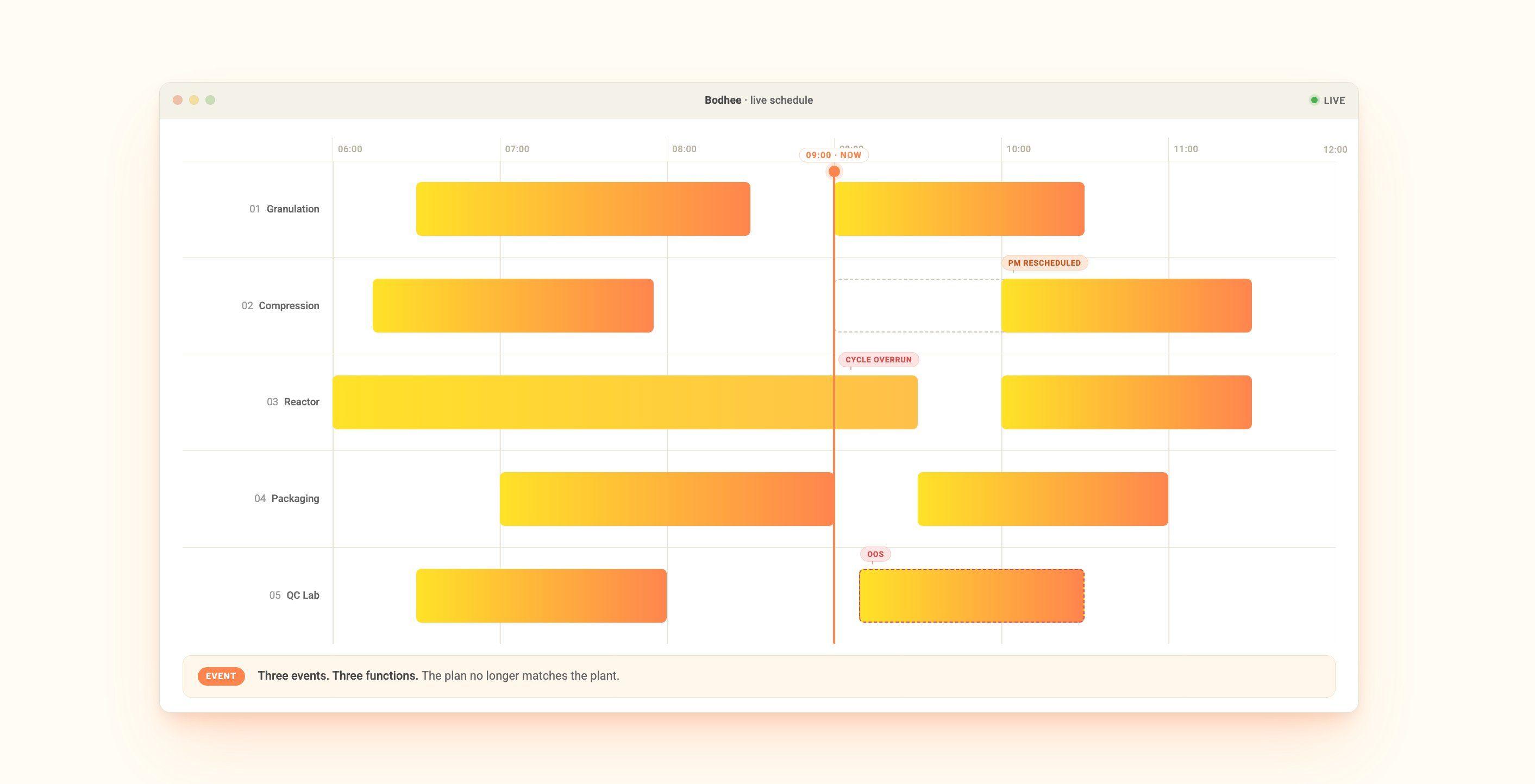
It's 06:00. The night shift handed off cleanly. The schedule that came out of yesterday's planning meeting still looks reasonable on paper. By 09:00, three things will have happened — and the schedule won't reflect any of them.
A reactor on Line 03 ran 40 minutes long on its sterilisation cycle. QC flagged an OOS on yesterday's batch B-4783; an investigation queue just got reshuffled. Maintenance has decided to bring forward a PM on the centrifuge because vibration trended out overnight.
Three events. Three functions. None of them know about the other two yet. The schedule on the wall still says everything is on plan.
This is the cadence inside most regulated process plants. The schedule isn't wrong because the planner is bad. It's wrong because it stopped being a plan the moment reality started moving.
What actually breaks between 07:00 and 09:00
Most production schedules in process manufacturing are built once a week, smoothed daily, and frozen at the start of each shift. That cadence assumes the plant follows the model. The plant doesn't.
In the first two hours of any shift, you'll typically see:
- A cycle running long. Cleaning, sterilisation, validation — the indirect activities that don't have a “Reschedule” button.
- An upstream completion that wasn't expected for another hour. Packaging is now short on inputs; a downstream line is suddenly idle.
- A QC event no one upstream has heard about. An OOS, an instrument calibration, or an analyst going home sick.
- A maintenance call that wasn't on the plan. A bearing temperature trend, a leak, a sensor failure.
By 09:00, the schedule and the plant disagree on the state of the day. The disagreement is not a bug. It's the predictable output of a system that publishes a forecast and calls it a plan.
Why the gap opens that fast
Three structural reasons, none of which are unique to any one plant.
1. The schedule doesn't model a third or more of the day.
Cleaning, changeover, validation, IPC, document closure — these consume a significant share of staffed time in regulated process manufacturing. Industry estimates put the figure above 30%, and in heavily multi-product batch plants it can run higher still. Most schedulers carry these activities as fixed buffers, if at all. When a CIP runs 40 minutes long, the model has no language for it. Downstream campaigns roll forward as if nothing happened. The schedule is technically correct and operationally fictional.
2. Unplanned downtime is the rule, not the exception.
The Siemens True Cost of Downtime 2024 study estimates that unplanned downtime costs the world's largest manufacturers around $1.4 trillion a year — roughly 11% of their combined revenues. The same body of research, alongside ABB's plant-maintenance survey of more than 3,000 facilities, finds that about two-thirds of manufacturing plants experience an unplanned downtime event at least once a month.
Whatever number a particular plant reports, the implication is the same: a non-trivial share of every month's production hours arrives unscheduled. None of it fits inside a weekly plan. It enters the day as it happens, and the schedule has no way to receive it.
3. Production, QC, and Maintenance schedule in silos.
This one compounds everything else. Each function builds a competent schedule against its own constraints. None of them can see the other two. When they collide — a campaign extends into a stability pull, a PM blocks a line that QC was about to release — someone negotiates it by phone or email. No public study cleanly quantifies what this misalignment costs across an industry, but anyone who has run a Monday-morning operations review in a process plant can name three or four examples from last week. The cost is real. It just doesn't show up neatly in a single line item, because by definition it lives between functions.
What the gap costs
Operational Equipment Effectiveness gives you the cleanest single read on it. Nakajima's TPM benchmark for world-class OEE is 85%. Industry benchmarking surveys consistently place typical OEE in regulated process manufacturing in the 35–65% range. The gap between the typical and the world-class is mostly not a machine problem. It's a sequencing problem.
The planner is not the reason for that gap. The cadence is. Once-a-week scheduling produces once-a-week-quality plans. Two hours into the shift, you're already inside the variance the plan didn't allow for — and there's no mechanism to put the plan back in sync, short of a phone tree and a Friday-afternoon rebuild.
The wrong fix and the right one
The wrong fix is to schedule more often with the same tool. Daily becomes hourly. The planner spends more time in front of the APS. The schedule still goes stale between rebuilds — just on a faster clock. You've made the planner busier without making the schedule any more current.
The right fix is structural. The schedule has to listen to events — every batch completion, every quality result, every maintenance alert, every operator confirmation — and re-solve against the full constraint state of the plant when those events change something material. Not a patched copy of yesterday's schedule. A fresh, feasible schedule built from the current state.
That's what event-driven scheduling actually means. Not a faster batch run of the old algorithm. A different architecture.
It also means production, QC, and maintenance are scheduling against the same model. When a reactor comes down, the maintenance schedule and the production schedule see the same event at the same instant. The misalignment between functions stops being structural and starts being addressable.
What this looks like in practice
Bodhee Production Scheduling is built around this idea. The scheduling engine — constraint programming with multi-objective optimisation underneath — re-solves on event arrival, not on a calendar. AI agents watch the event stream from MES, ERP, LIMS, and the historian; they classify what matters; the engine rebuilds the plan in minutes, not hours. The schedule and the plant don't drift apart, because the schedule is always derived from the current state, not from yesterday's snapshot of it.
You don't get a perfect day. You get a day where 09:00 doesn't already invalidate the plan.
If that's closer to how your plant actually runs, that's the product.
See Bodhee on a plant like yours
30-minute demo with a solutions engineer who's shipped this on a process plant. No slide decks unless you ask.

See it in action
Production Scheduling
Explore the deployments, architecture, and ROI math behind dynamic scheduling for your plant.
See Production Scheduling