
A shared-equipment API site freed enough capacity for five extra CDMO batches a year
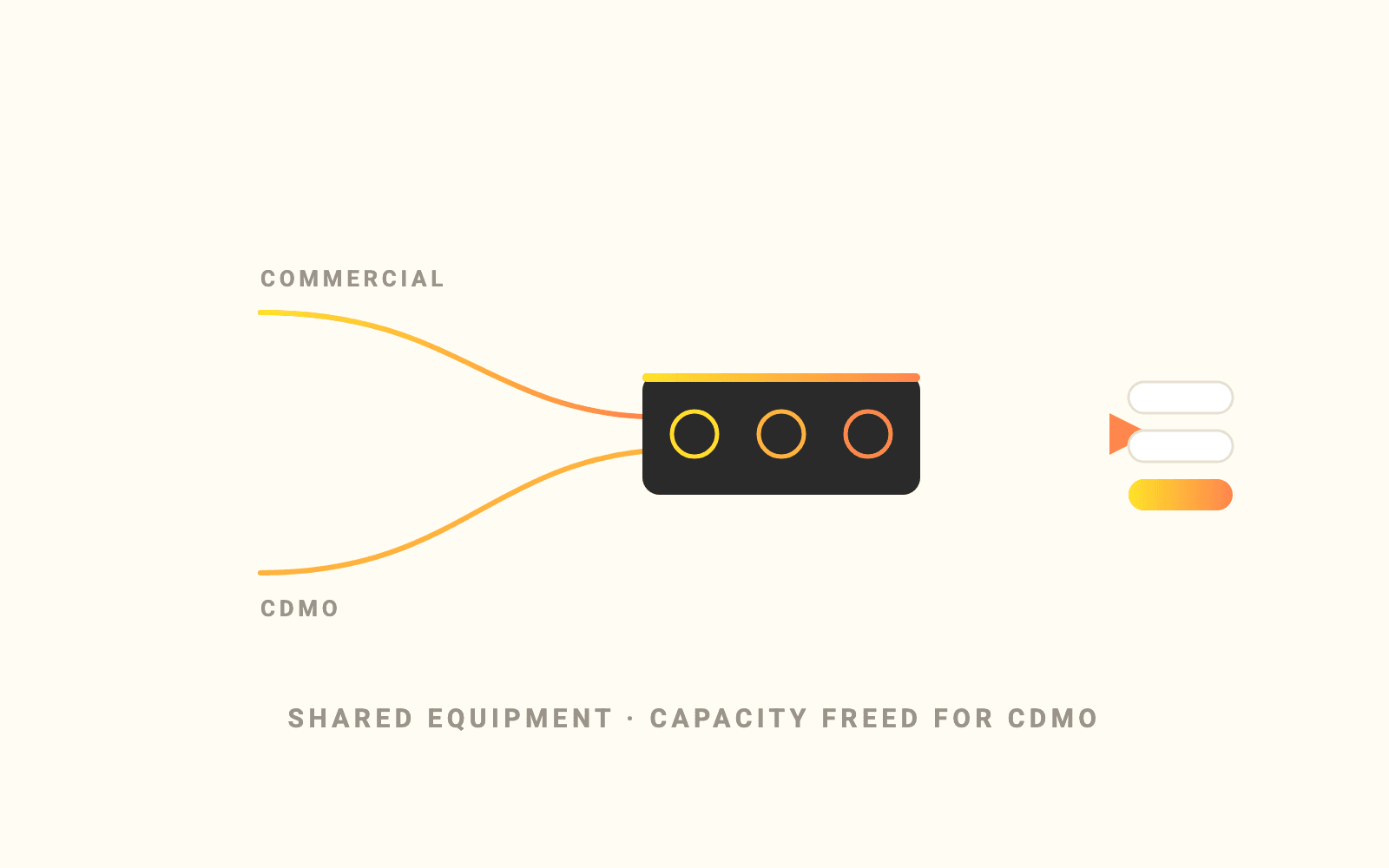
A major European pharma manufacturer ran commercial and CDMO production on shared equipment, planned in Excel. Bodhee Production Scheduling, deployed as a Control Tower, cut commercial lead time 2.5% and freed capacity for five extra CDMO batches a year.
Extra CDMO batches a year
Commercial lead-time improvement
Measured on commercial production scheduled through the Bodhee Control Tower.
Extra CDMO batches a year
Capacity freed by the 2.5% commercial gain, reallocated to higher-value CDMO production.
Replanning after actualization
Was one to two hours by hand; the Control Tower now replans immediately on a shop-floor resource issue.
Scenario analysis per run
What-if analysis that took four to five hours of manual rework now runs against the live model, so capacity options get explored rather than skipped.
The objective
Free capacity on the site's commercial production lines through tighter, constraint-aware scheduling — then reallocate that capacity to higher-value CDMO batches the dedicated contract unit could not otherwise have taken on.
The challenge
Where the previous approach fell short
01
One plan, planned in Excel
Every material had its own task list — FTE, standard duration, sequence-number dependencies — scheduled at overall-capacity level in spreadsheets. Replanning after each actualization took one to two hours by hand.
02
Commercial and CDMO share equipment
A dedicated CDMO unit ran in its own building and line but drew on equipment shared with commercial production. Without a live shared-equipment view, contract work and commercial batches competed blind.
03
Scenario analysis was slow
Each what-if — a new transfer, a CDMO product, a short-term plan change — took four to five hours of manual rework, so options went unexplored and capacity decisions were made without them.
04
Capacity lost in the planning gap
The gap between the production plan and shop-floor reality cost capacity the site could have sold. Every hour of unbooked equipment time on the CDMO line was contract revenue left on the table.
The full constraint universe — the operational dimensions out-of-the-box schedulers can't hold
Shared commercial + CDMO equipment
A dedicated CDMO unit runs in its own building and line but draws on equipment shared with commercial production, so contract and commercial batches compete for the same machines.
Batch-record stepwise build
Commercial products build stepwise from their batch records, each step gated by the completion of the one before it.
General-recipe CDMO products
CDMO products run on general recipes composed from standard building blocks, with complete recipes held for the most common compositions.
Primary and alternate equipment
Most processes can run on a preferred primary machine or named alternates, so the scheduler chooses among equipment options for every batch.
Batch-size-driven capacity
Effective capacity changes with batch size, so the same equipment yields different throughput depending on the order in front of it.
Equipment-specific cleaning cycles
Each piece of equipment carries its own cleaning cycle between batches and campaigns, adding changeover time the plan has to respect.
The CDMO unit had its building, line, and equipment , products- and the entire plan in Excel. For each material, planners kept a detailed task list: FTE, standard duration, and dependencies expressed as sequence numbers. Scheduling was done at overall-capacity level, not down to the specific equipment, and every actualization on the floor meant one to two hours of manual replanning. A single demanding scenario analysis - a new transfer, a new CDMO product - cost four to five hours of rework.
The harder problem sat underneath the spreadsheet. Commercial production and CDMO ran on shared equipment, and the schedule had to hold six dimensions of complexity at once: shared commercial and CDMO equipment, the stepwise batch-record build of commercial products, general-recipe CDMO products, multiple primary and alternate equipment choices, capacity that changed with batch size, and equipment-specific cleaning cycles between batches and campaigns. Commercial cycle times fluctuated; CDMO processes carried even more uncertainty. There was little visibility across the shared lines and little information-sharing between units.
The cost was the gap between the production plan and what the floor actually did — and that gap was lost capacity. On a site where freed equipment time on the CDMO line is contract revenue, every hour the plan failed to recover was money left on the table.
What Bodhee did
How Bodhee rebuilt the plan
Bodhee brought Adaptive Scheduling to the site as a production Control Tower — Bodhee Production Scheduling, supporting both the daily plan and its execution. It deployed alongside the site's existing SAP environment rather than replacing any of it.
The integration spine was deliberately narrow. Process orders and stock and inventory data flowed from SAP ERP into Bodhee through SAP MII. No MES or SCADA feed was in scope: rather than pull live tag streams, the Control Tower tracked shop-floor confirmations and task status directly, putting site and shop-floor teams on a single shared plan.
The model was the work. The Control Tower had to schedule two kinds of production on the same equipment. Commercial products build stepwise from their batch records; CDMO products run on general recipes — composed from standard building blocks, with complete recipes for the most common compositions. Both draw on multiple primary and alternate equipment options, with capacity that depends on batch size and cleaning cycles specific to each piece of equipment between batches and campaigns. Bodhee encoded those six dimensions once and planned across them, with MPS planning that accounts for human-resource availability, stock, and inventory.
Rollout ran over sixteen weeks: discovery and integration scoping, model build, then a shadow-mode period where the Control Tower planned in parallel with the spreadsheet before daily planning moved across at cutover.
In live use, two behaviours changed the planners' day. When a resource issue surfaces on the floor, the Control Tower replans immediately instead of waiting for the next manual pass. And a continuous Bill-of-Routine check compares the standard plan against the real one, so drift between plan and floor surfaces as it happens rather than at the next review.
01
Control Tower with SAP integration
Bodhee Production Scheduling deployed as a production Control Tower, taking process orders and stock and inventory from SAP ERP through SAP MII. No MES or SCADA feed was in scope.
02
One model for both production types
The Control Tower modelled commercial batch-record builds and general-recipe CDMO products together — primary and alternate equipment, batch-size-driven capacity, equipment-specific cleaning — on the shared equipment they compete for.
03
Replan on the resource issue
When a shop-floor resource issue surfaces, the Control Tower replans immediately instead of waiting for the next manual pass. Confirmations and task status are tracked in Bodhee directly.
04
Continuous standard-versus-real check
A continuous Bill-of-Routine check compares the standard plan against actuals and runs MPS planning against human-resource availability, stock, and inventory — keeping the plan honest as the floor moves.
On the roadmap
QC-release timing is the next constraint to enter the model, followed by bringing the dedicated CDMO unit's general-recipe planning into the same shared-equipment Control Tower — extending live, constraint-aware scheduling from the commercial lines across the rest of the site.
The engagement
From discovery to cutover
Weeks 1–4
Discovery
Mapped the Excel task lists, shared-equipment constraints, and CDMO recipes; agreed the SAP-to-MII integration scope and the capacity baseline to measure against.
Weeks 5–9
Model build
Encoded commercial batch-record builds and general-recipe CDMO products, shared equipment, batch-size-driven capacity, and equipment-specific cleaning cycles into one scheduling model.
Weeks 10–13
Shadow mode
Ran the Control Tower in parallel with the spreadsheet plan, validating its schedules and replanning behaviour against the planners' manual work before cutover.
Weeks 14–16
Cutover
Moved daily planning onto the Control Tower; planners shifted from rebuilding spreadsheets to reviewing proposals and tracking confirmations in Bodhee.
The outcome
What changed on the ground
Commercial lead-time improvement
Extra CDMO batches a year
One model, two production types
Commercial batch-record builds and general-recipe CDMO products are now planned together on the equipment they share, not at overall-capacity level in Excel.
Freed capacity sold as CDMO work
A 2.5% commercial lead-time gain was reallocated to the dedicated CDMO unit as five extra contract batches a year — capacity recovered from the plan-to-floor gap, sold rather than left as slack.
Replan on real events, not the next pass
A shop-floor resource issue now triggers an immediate replan instead of a one-to-two-hour manual rebuild, and scenario analysis runs against the live model rather than four-to-five hours of rework.
Why this matters beyond one site
The pattern generalises to any API or fine-chemicals site that runs contract and commercial production on shared equipment. The commercial side — higher volumes, mature processes, plannable well in advance — is where constraint-aware scheduling reclaims capacity. The contract side is where that reclaimed capacity earns the most, because an hour of equipment time sold as CDMO work is worth more than an hour saved on a commercial batch. A small percentage gain on the larger, steadier flow funds additional high-value batches on the same assets.
What does not generalise is the constraint set. Shared-equipment cleaning cycles, batch-size-driven capacity, and the mix of batch-record and general-recipe products differ site to site. The work is encoding that specific combination once, then scheduling both production types against it — which is where the plan-to-floor gap, and the capacity hiding inside it, finally closes.