
10–15% Equipment Utilisation Uplift: rebuilding production scheduling at a major European API manufacturer
A European API manufacturer retired its in-house planner for Bodhee Production Scheduling — lifting equipment utilisation 10–15% and productivity 8–10% once shelf-life, lockstep, and cross-building dependencies entered the model.
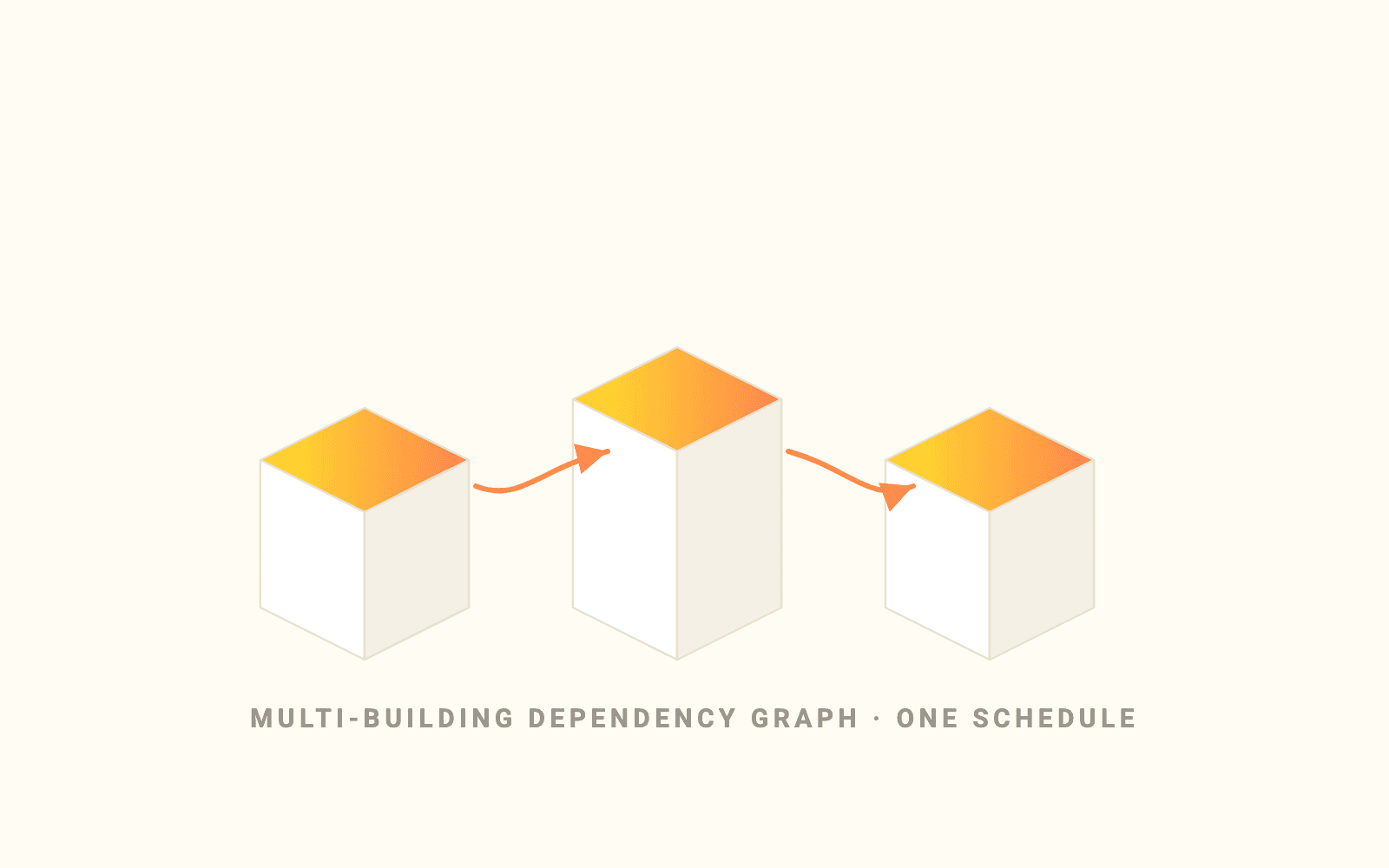
Equipment utilisation uplift
Equipment utilisation
Cleaning is modelled as a first-class process and the scheduler minimises the equipment touched within a campaign — so equipment spends more of the day producing, not cycling through changeover.
Productivity
The cumulative effect of dependency-aware rescheduling, lower cleaning and changeover overhead, and higher equipment utilisation freeing up capacity across the production day.
Shelf-life and downstream dependencies under change
Shelf-life windows and downstream batch dependencies are honoured in the same rescheduling pass — constraints the previous in-house tool could not represent.
Optimised multi-equipment campaigns
Preparation and cleaning run as first-class processes linked to production at task level; the scheduler minimises the equipment used within a campaign, reducing changeovers between batches.
The objective
Replace a custom in-house planning tool that could not represent shelf-life, multi-equipment lockstep, alternate-equipment paths, or cross-building dependencies with Bodhee Production Scheduling — and compound deployment speed building by building so the entire site transitions within a single programme.
The challenge
Where the previous approach fell short
01
Shelf-life-constrained intermediates
Once a time-constrained intermediate is produced, the downstream batch must consume it within an allowable window or the material is lost — a constraint the in-house tool could not represent.
02
Multi-equipment lockstep
Some processes require three pieces of equipment available simultaneously; the in-house tool scheduled equipment independently, missing lockstep conflicts until the floor discovered them.
03
Forward-propagated delays
When a delay hit, the in-house tool pushed every downstream task by the delay window plus a buffer — turning a one-shift slip into a week-long underutilisation of entire equipment trains.
04
Cross-building dependency graph
Batches sequence across buildings with intermediates moving between them; the in-house tool scheduled each building independently, reconciling conflicts after the fact rather than preventing them.
The full constraint universe — the operational dimensions out-of-the-box schedulers can't hold
Process-order demand
Scheduling input is a stream of process orders, each representing one batch with a tentative start date.
Batch-to-batch sequencing
One or more upstream SFG batches must complete before a downstream SFG or FG batch can start.
Strict shelf-life windows
Once a time-constrained intermediate is produced, the downstream batch must consume it within an allowable window, or the material is lost.
Equipment as the primary constraint
Machinery dictates capacity; operator capacity is respected as a constraint but not individually slotted.
Preparation activities
Many products require prep activities to finish before a batch begins.
Cleaning activities
Many products require cleaning activities after a batch, to prevent contamination in a multi-product environment.
Equipment reusability
Most equipment is reusable across processes and products, not dedicated.
Multi-equipment lockstep
Some processes need three pieces of equipment available simultaneously.
Alternate equipment
A primary piece is preferred; named fallbacks are used when the primary is unavailable.
Campaign-level equipment minimisation
Running a campaign efficiently means minimising the number of equipment touched, so cleaning overhead doesn't compound.
For years, the site's scheduling graph lived in a single in-house planning tool — a custom application that handled local process-flow masters and equipment mapping, and rescheduled by pushing every downstream date out by the delay window plus a buffer. It couldn't see shelf-life, lockstep, alternates, or cross-building flow.
When a delay hit, the tool forward-propagated every task on that equipment by the delay window — turning a one-shift slip into a week-long underutilisation. Alternative paths existed: a few processes could have moved to alternate equipment, a few batches could have re-sequenced. The tool didn't see them. The planner did — in their head — but couldn't rebuild fast enough to act on what they knew.
What Bodhee did
How Bodhee rebuilt the plan
Bodhee Production Scheduling replaced the in-house tool building by building. Each building reused the work of the previous one — the plant's operating logic was encoded once, then adapted.
01
Captured the plant as a live model
Equipment, materials, dependencies, shelf-life, preparation, and cleaning encoded as the scheduler's source of truth — every constraint the in-house tool couldn't hold now entered the model.
02
Solved the equipment combinatorics
Equipment treated as a reusable pool with lockstep, alternate-equipment preferences, and campaign-level minimisation — the scheduler finds configurations the planner couldn't rebuild fast enough to act on.
03
Single source of truth via SAP MII
Process orders flow from SAP ERP through SAP MII into Bodhee; schedule confirmations tracked in Bodhee directly. No parallel system, no Excel handoff.
04
Compounded speed building by building
First building took sixteen weeks; each subsequent building reused master-data templates, resource patterns, and constraint encodings — only site-specific differences needed work.
On the roadmap
QC integration is next. Production-to-production scheduling across sister sites follows — closing the same dependency loop that today operates inside the building, end to end across the manufacturer's footprint.
The engagement
From discovery to cutover
Weeks 1–4
Discovery
Mapped the dependency graph across the first building — equipment, materials, shelf-life windows, batch-to-batch sequencing, and cleaning activities catalogued.
Weeks 5–10
Model build
Encoded ten scheduling dimensions into Bodhee Production Scheduling; integrated process-order feed from SAP ERP via SAP MII.
Weeks 11–14
Shadow mode
Ran Bodhee schedules alongside the in-house tool for the first building; planners compared outputs and flagged constraint gaps.
Weeks 15–16
Cutover
In-house tool retired for the first building; planner role shifted from schedule construction to review and exception handling.
The outcome
What changed on the ground
Equipment utilisation
Productivity
Dependency-aware rescheduling
When a delay propagates upstream, Bodhee respects the shelf-life of the intermediate and the dependencies of every downstream batch in the same pass. The schedule reflects reality when it leaves the system, not just when it was built.
Equipment capacity unlocked
With cleaning modelled as a first-class process and the scheduler minimising equipment touched within a campaign, the same equipment spends more of the day producing. Forward-propagated delays no longer strand whole equipment trains.
Planners review, not build
The forward-propagated cascade that used to consume the week is now a system event. The planner's role has shifted from construction to review and exception handling — when the system makes a trade-off, the constraints behind it are visible.
The biggest change wasn't the speed — it was finally being able to trust that the system wouldn't schedule a batch we couldn't actually run.
Why this matters beyond one site
Multi-building API manufacturing — and process manufacturing more broadly — runs on dependency graphs, not standalone schedules. A site that schedules each building independently isn't really scheduling; it is making promises in each building and reconciling the conflicts after the fact. Constraint-aware scheduling that holds shelf-life, batch-to-batch sequencing, multi-equipment lockstep, alternate-equipment preference, and campaign-level equipment minimisation in the same model — and rebuilds fast enough to keep up with delays — is the version of scheduling that matches how these plants actually operate.
The same shape of deployment applies wherever production is multi-building, multi-equipment, and time-sensitive. Routing orders through a manufacturing integration layer rather than directly between ERP and scheduler keeps the scheduler clean of system-of-record changes.