
How Dynamic Production Scheduling Works
Dynamic production scheduling is not a faster weekly rebuild. It is an event-driven loop: one QC hold clears fourteen hours late, and the model re-solves from the plant's real state while the planner releases the plan.
 2 Sept 202613 min read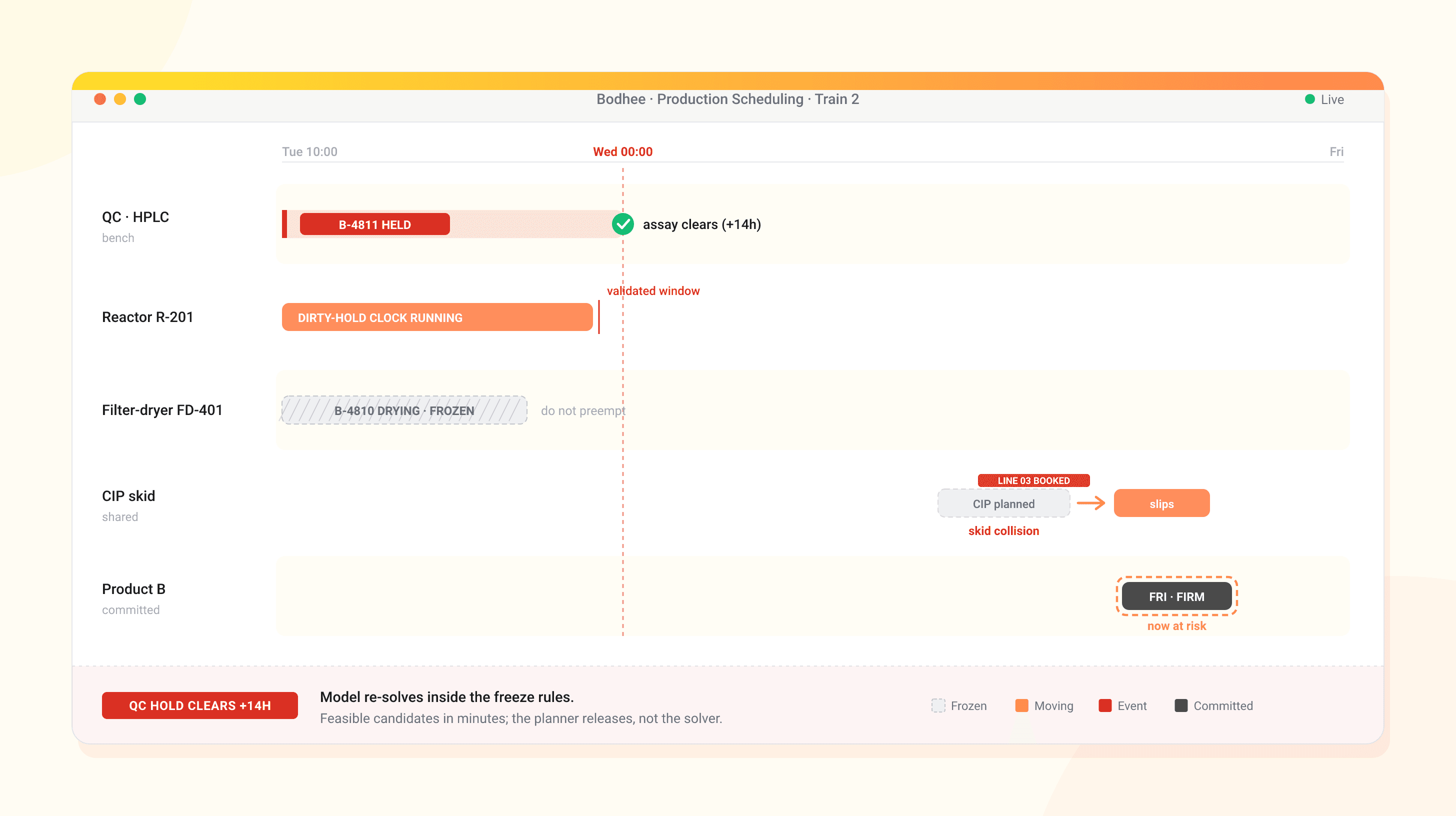
Tuesday, 10:00. Batch B-4811 of intermediate INT-A is supposed to leave QC. The HPLC result does not arrive. The hold stays on.
Wednesday, 00:00. Fourteen hours late, the assay clears. The planner is not in the building. The weekly plan still has B-4811 transferring into crystalliser CR-301 at Tuesday 14:00, filter-dryer FD-401 loading at Wednesday 06:00, and the end-of-campaign CIP occupying the CIP skid from Thursday 08:00 so Product B can start Friday.
None of that is still true. The question is whether anything in the architecture can say so.
I have already written about why a static plan is wrong two hours into the shift. This is not that argument again. Dynamic production scheduling is what the architecture does next: it re-solves from the plant's current state when an event lands, instead of defending a plan that reality has already broken. This post is the mechanism, object by object, when one process event lands on a train.
The scene below is a composite. It is the shape of a week on a multi-purpose API train, not a customer story.
Four ways a plant rebuilds a schedule
If you are still deciding what production scheduling software even has to do, start there. This post assumes you already run a plan and asks what happens the moment it breaks.
People say "dynamic scheduling" and mean four different loops. Mixing them is how every vendor ends up claiming real-time AI.
Static. The plan is built once, often Sunday night, often from last week's snapshot, and executed as written. Variance is managed by people. The schedule is a photograph of an intention. It is the spreadsheet standing in for a live plan.
Periodic. The engine rebuilds on a clock. Nightly. Shiftly. Weekly. Between rebuilds the plant keeps moving and the plan does not. You have made the planner busier. You have not made the schedule current.
Event-driven. A disturbance is detected (a hold clears, a CIP overruns, a tank hits high-high, a utility trips) and the model re-solves from current state, not from a patched copy of yesterday. That is a different architecture, not a faster batch run of the old one.
Hybrid. High-impact events trigger a re-solve. Parameter drift and noise wait for the next periodic pass. Practitioners who have lived through a thrashing Gantt land here. The operations-research literature named the trade-off decades ago: responsiveness versus nervousness. Hybrid is a policy the plant sets. It is not a slogan on a box.
Most installed "APS with a reschedule button" is periodic. The button is still a person.
What counts as a material event
In a discrete shop the textbook disruption is a machine down. In a process plant the events that actually break the week are different. They destroy material, not just a due date.
A useful list, not an exhaustive one:
QC hold / late release / OOS freeze. The batch is physically done. It is legally unavailable.
Hold-time clock. Process hold, dirty hold, clean hold. Hard clocks. A Gantt that is "on time" and chemically illegal is not a plan.
CIP / SIP / validation overrun. Cleaning is a process with a skid, solvents, operators, a recipe. Not a setup cell. In a regulated plant these indirect activities routinely eat a third or more of staffed time.
Tank block. Volume over time, plus compatibility. A full tank stops the train upstream.
Utility trip. Steam, nitrogen, vacuum, purified water, waste. Invisible to a reactor-only Gantt.
Yield short, rush/campaign cut, CMMS asset event. The material plan moves, a committed CDMO slot is threatened, or a PM now sits on the vessel the campaign needs.
MES actuals, LIMS results, historian, CMMS, operator confirmations: those are the feeds. Without them, "dynamic" is a faster wrong plan. Not every event should re-solve. A two-minute instrument blip should not. A hold that gates the next charge should.
Walkthrough: hold clears fourteen hours late
Train 2 is a short API train. Reactor R-201, crystalliser CR-301, filter-dryer FD-401. Shared CIP skid. Shared QC HPLC bench. Campaign of INT-A: four batches, then a validated end-of-campaign clean, then Product B on Friday.
Tuesday 10:00 the INT-A assay does not land. B-4811 sits. The dirty-hold clock on R-201 is running. CR-301 is empty and waiting. FD-401 is still finishing B-4810. Product B's Friday slot is downstream of a CIP that has not started.
What is frozen
Three things should not move, even if the engine is fast.
The in-process batch. B-4810 is in the dryer. You do not preempt it because a solver found a prettier makespan.
The dirty-hold clock. R-201 cannot sit dirty past the validated window. If the hold on B-4811 eats that window, the legal next step is a clean you did not want, not a creative resequence.
Locked campaign slots. If Product B is a committed CDMO campaign, Friday is not a suggestion. Stealing the suite for a rush is an ethics problem and a math problem. The model should know the slot is firm before it offers to break it.
Freeze is a policy. It is not the solver being timid. A plant that cannot freeze in-process work will thrash the floor every time QC is late, which is most weeks.
What has to move
The late release does not stay in the lab. It walks.
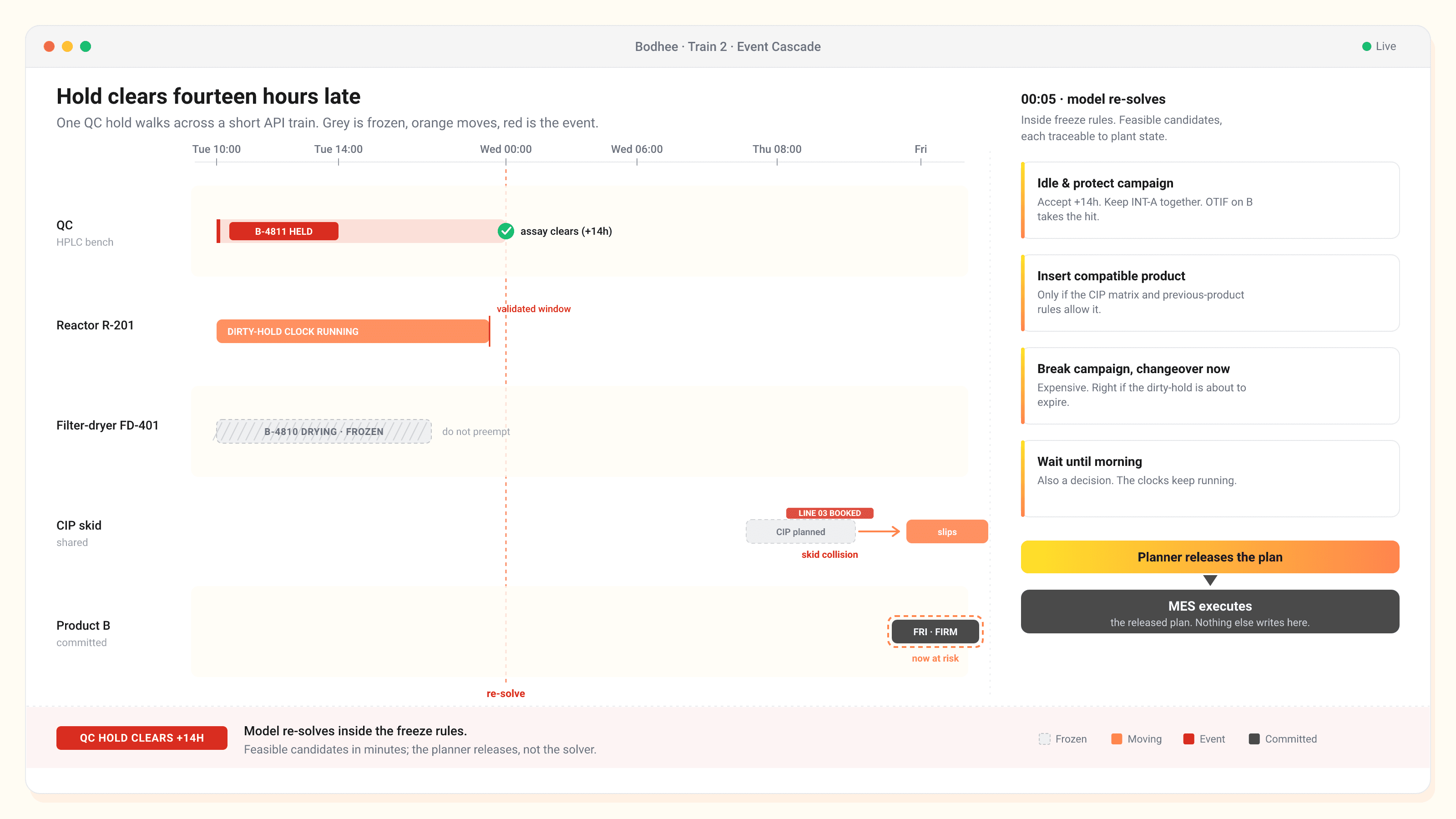
CR-301's Tuesday 14:00 charge is now Wednesday 00:00 at best, plus whatever the transfer policy allows. FD-401's Wednesday 06:00 load slides. The end-of-campaign CIP that owned the skid from Thursday 08:00 collides with Line 03, which already booked the same skid for a product-to-product clean. Product B's Friday start is now a question, not a date.
Two other clocks have woken up. The process hold on the isolated intermediate from B-4810. The clean-hold that will start the moment the overdue CIP finally runs. Either can make a "recovered" Friday start illegal.
A weekly snapshot cannot see this cascade. It was taken before the assay failed to arrive. A production-only Gantt cannot either: the HPLC bench and the CIP skid do not live on it. The economics of that blindness is the silo tax. The mechanism is simpler: one event, three calendars, no joint model.
What the planner sees
At 00:05 the hold clears. In an event-driven architecture the sequence is not "email the planner at 07:00."
The event hits the live model. Impact assessment: which batches, which clocks, which committed slots. The engine re-solves inside the freeze rules. What comes back is not a single Gantt forced on the night shift. It is a small set of feasible candidates, each traceable to plant state.
Typical forks on this train, still composite, still the shape of the decision, not a prescription:
Idle the train and protect the campaign. Accept the fourteen hours. Keep INT-A together. Slide CIP. Tell Product B the truth on Friday. Material on a clock is protected; OTIF on B takes the hit.
Insert a compatible product whose cleaning from the current state is allowed. Only if previous-product eligibility and the CIP matrix say so. This is where a discrete-style "just put Job X on Machine 2" answer goes illegal.
Break the INT-A campaign and take the validated changeover now. Expensive. Sometimes right, if the dirty-hold is about to expire, or if Product B is the committed slot that cannot move.
Do nothing until morning. That is also a decision. The clocks keep running while you wait.
Minutes later the planner, or the night supervisor under a standing rule, sees the forks, the orders now at risk, and why. They pick. The released plan is the plan. MES executes that, not a scenario someone liked in a workshop.
That is the loop. Event. Freeze. Re-solve. Explain. Release. Execute.
The time that matters is time-to-feasible, not time-to-pretty. On a single plant, that rebuild is typically minutes. It is not instantaneous, and it should not be autonomous.
Freeze horizon vs replan horizon
Two horizons, always, or the Gantt thrashes.
Freeze horizon. Work that is in process, plus slots the plant has promised. The engine may not break these without an explicit override. In a cGMP train this is also a quality decision: you do not silently resequence a released campaign.
Replan horizon. Two layers, because the questions differ.
Next 24–48 hours, granular: batches, CIP, QC gates. The operating layer. Where a late assay lives.
Next 2–4 weeks, tactical: campaign boundaries, cleaning-validation windows, maintenance clusters. The weekly APS still owns those boundaries. The operating layer is not the S&OP.
If you re-solve the four-week campaign wheel every time an HPLC is fourteen minutes late, you will burn planner trust and you will never execute. If you freeze the next 48 hours and ignore the assay, you will expire an intermediate. The policy is the product of those two facts.
Why rescheduling too often fails
Nervousness is the name for a schedule that will not sit still long enough to be run.
In a process plant it is more expensive than in a job shop, because breaking a campaign mid-train can force a validated changeover you just amortised. Operators stop believing the board. Supervisors freeze the system and go back to the workbook. That failure mode is widely reported and widely ignored by anyone selling "reschedule every ten minutes."
The wrong fix, as I have said before, is to schedule more often with the same tool. Daily becomes hourly. The planner lives in front of the APS. The schedule still goes stale between rebuilds.
The right fix is a filter. Material events re-solve. Noise notifies. Freeze rules hold the floor still. The planner releases the result. Hybrid policy, event-driven engine.
Adaptive, operationally
"Adaptive," "dynamic," "real-time," "AI," "agentic": the words are exhausted. Buyers have heard all of them on APS datasheets.
We use Adaptive Scheduling as an operating definition, not as atmosphere. If a vendor cannot answer the five questions below, they are describing a faster snapshot.
What event class triggers a re-solve, and what only notifies?
QC release, hold-time breach, CIP overrun, tank block, utility trip, and CMMS window re-solve. Heartbeats do not.
What horizon re-solves?
Minutes for a feasible next 24–48 hours, inside weekly campaign boundaries.
Whose constraints move together?
Production, CIP as a process, QC, and maintenance. One live model. If only production moves, you have sharpened one island.
How long to a feasible, explainable plan?
Minutes, on a single plant. If the planner cannot see why, they freeze the system.
Who releases the plan?
A person. Override is first-class.
That is the category we are in. Adjacent to APS, not a synonym. APS still answers "what is the best plan for next week?" Adaptive Scheduling answers "given everything that has changed in the last hour, what is the best plan for the next 24 hours, and which orders are now at risk?"
The stack that follows from this (IBP/S&OP → site campaign plan / APS → adaptive batch+CIP+QC schedule → MES/LIMS/CMMS) is the next post in this series. The short version: we sit above MES and below planning. We do not replace either.
The planner is still in the loop
Will Adaptive Scheduling replace planners? No.
The planner is competent. The architecture was not. A model that re-solves in minutes without an explainable recommendation is a black box with a shorter clock. A model that dispatches itself in a cGMP plant is a quality event waiting for an auditor.
What the planner still decides, on the INT-A night:
- Which candidate to release.
- Whether a committed slot is truly firm.
- Whether to spend a validated changeover to save a hold-time.
- Whether a what-if stays a what-if.
What-if scenarios are decision support. Dispatch is a committed plan. Mixing them is how a workshop Gantt becomes last Tuesday's incident.
AI agents watch the event stream, classify what is material, assess impact, and trigger the re-solve. They do not write the schedule in language. Constraint programming still enforces hard rules; multi-objective optimisation still trades throughput, OTIF, changeover, utilities. An LLM may explain a recommendation. It does not replace the solver.
If this is the day you actually run
This is not a reschedule button on a weekly APS, and it is not MES. MES executes and records; most deployments leave it untouched. It is not a promise that 09:00 will be quiet, and it is not autonomous execution. You do not get a perfect day. You get a day where a hold that clears at midnight produces a feasible plan before the night supervisor has to invent one.
Bodhee Production Scheduling is built around this loop. Three products, Production, Quality Control, and Maintenance, can run against one Process Digital Twin, so a QC event and a CIP skid and a CMMS window replan the same plant. You do not have to buy all three on day one. The architecture does not force the bundle. Production alone still has to see holds and cleaning as constraints, or the walkthrough above is fiction.
Bring us the last time a QC hold cleared late on a real train. Not a sanitised demo dataset. The freeze list, the CIP matrix, the campaign that was at risk. We will show the event, the candidates, and who would have released the plan, in minutes, not as a story about minutes.
If you already run a weekly APS and the next 24 hours still lives in a workbook, that is the conversation. The APS can keep the week. The operating layer has to keep the night.

See it in action
Production Scheduling
Explore the deployments, architecture, and ROI math behind dynamic scheduling for your plant.
See Production Scheduling