
Why process plants still schedule in spreadsheets, and what replaces them
The production spreadsheet doesn't fail because your planner is careless. It fails because it can't see the plant in real time. Here's what event-driven, constraint-aware Adaptive Scheduling puts in its place.
 17 Aug 20269 min read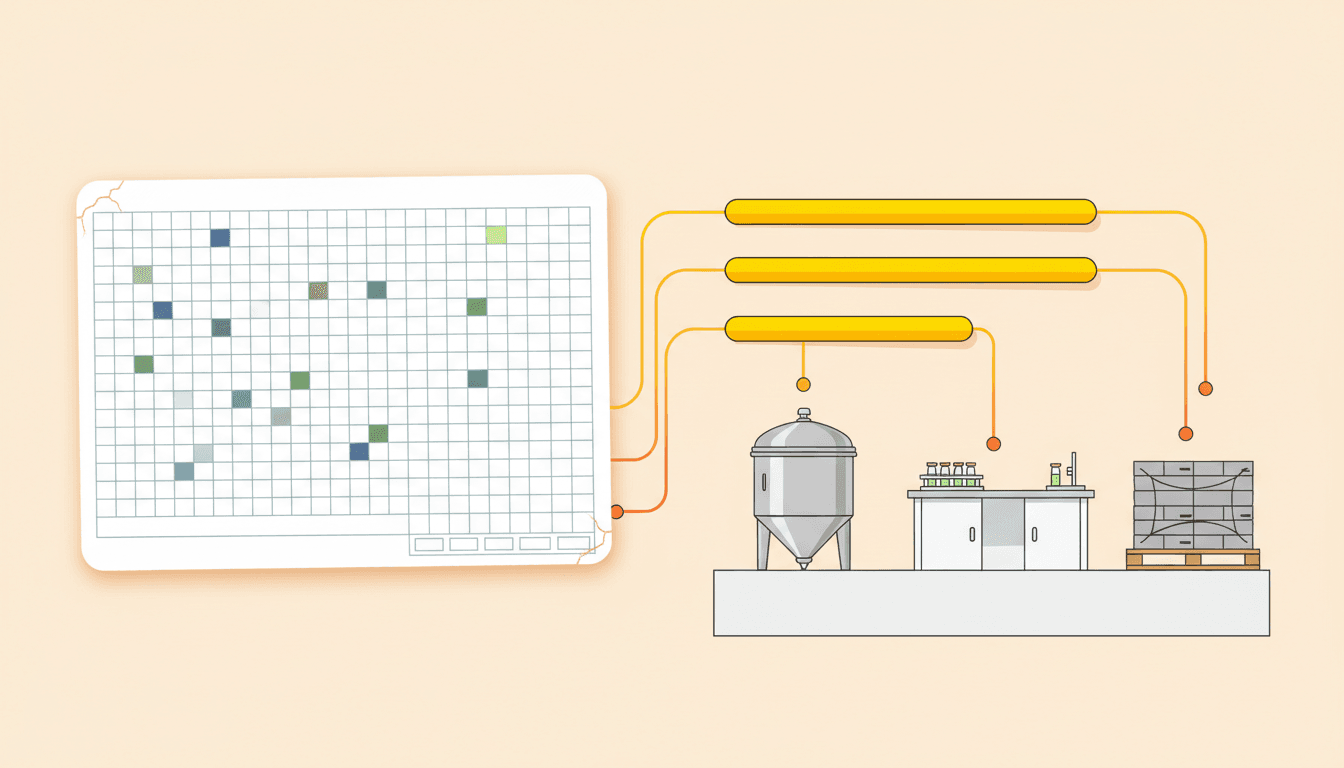
There is a workbook. It has a name like Master_Schedule_v14_FINAL_rev3.xlsx. It lives on a shared drive, it has forty tabs, and one person understands the macros. When that person is on leave, the plant schedules more slowly.
If that describes your operation, you are in the majority. Most process plants running pharma, biotech, or specialty chemicals still build the production schedule in a spreadsheet. Not because the planner is behind the times. Because the spreadsheet was the only tool flexible enough to hold the plant's real constraints when nothing better existed, and switching costs are high.
The spreadsheet is not the problem. Depending on it as the live plan is.
What the spreadsheet was actually holding together
Give a good planner a blank grid and a week, and they will encode an astonishing amount of tacit knowledge into it. Reactor changeover sequences. Which analyst is qualified for which assay. The unwritten rule that Line 2 never runs product A straight after product C because the clean takes too long. A spreadsheet absorbs all of it, quietly, in formulas and colour-coding and a legend only the author can read.
That is the trap. The knowledge is real and valuable, and it is trapped in a document that cannot act on it. The spreadsheet records the plan. It cannot re-solve the plan. So the moment the plant moves away from the assumptions baked into row 400, the planner is back at the keyboard, dragging blocks by hand.
Four failure modes show up in almost every plant that has outgrown the sheet. They are worth naming precisely, because each one maps to a specific thing an adaptive scheduler does differently.
The four places the spreadsheet quietly fails
Version chaos: nobody knows which file is the plan
The schedule gets emailed to the floor Monday morning. By Tuesday, production has a marked-up copy, QC is working from a screenshot in an email and a Teams group, and the warehouse is looking at last week's tab because the link in the email pointed at the wrong file. There is no single source of truth. There are five sources, and they disagree.
This is not a discipline problem you can train away. A file that gets copied, emailed, and locally edited will fork. That is what files do. The plant needs one live plan that everyone reads from the same instant, not a document that scatters into variants the moment it leaves the planner's screen.
No real-time constraints: the plan can't see the plant
A spreadsheet is a photograph. It captures the plant's state at the moment the planner hit save, and it stops updating there. It does not know that the reactor on Line 3 is still in a clean cycle, that batch B-4471 just failed release and freed an analyst, or that raw material for the afternoon campaign is stuck at goods-in.
So the schedule and the plant drift apart, and they drift fast. We wrote about how quickly in Your schedule is already wrong by 9 a.m.: in most plants the plan and the floor disagree within two hours of shift start. A spreadsheet has no mechanism to close that gap. It cannot listen for a batch completion or a maintenance alert. It waits for a human to notice and retype.
Manual replanning: the cost lands on your most experienced people
When reality diverges, someone has to rebuild the sheet. That someone is usually your best planner, and the work is neither fast nor creative. It is dragging bars, re-checking that no reactor is double-booked, confirming an operator isn't scheduled across two lines, and re-verifying material availability by hand. On a bad day it eats the morning.
Planned, indirect activities make this worse, because the spreadsheet barely models them. Cleaning, changeover, validation, and QC hold consume more than 30% of staffed time in regulated process manufacturing (industry-reported), and most spreadsheets carry them as fixed buffers, if at all. When a clean runs long, the planner absorbs the shock manually. We unpacked that hidden third in The 30% problem.
Brittle on disruption: one event, and the whole thing has to be rebuilt
The spreadsheet's fatal weakness is that it has no notion of feasibility it can defend. Move one block and nothing warns you that you've just scheduled a technician who isn't qualified for that assay, or pushed a batch past its clean-hold expiry. The planner is the constraint engine. Every re-solve runs at human speed and carries human error.
So when a real disruption hits, a line down, an OOS, an urgent customer order, the plant does not re-optimise. It patches. It protects the one order everyone is shouting about and lets the second-order consequences fall where they fall. The full cost of that shows up as capacity you never recover, spread thinly across the month where no single line item can catch it. That is the argument in The silo tax.
What "adaptive" actually changes
Adaptive Scheduling is an event-driven, constraint-aware approach to production planning that re-solves the schedule automatically as plant events arrive, keeping every plan feasible by construction. It is not a faster spreadsheet, and it is not the same algorithm run more often. It is a different architecture, and two properties do the heavy lifting.
It is event-driven. Instead of waiting for a planning meeting, the scheduler listens to the plant. A batch completes, a quality result posts, a maintenance alert fires, an operator confirms a task. Each event is an input. When something material changes, the schedule re-solves against the current state of the plant, not against last Monday's snapshot of it. Hours-long rebuilds become minutes.
It is constraint-aware. The rules the planner used to hold in their head become explicit constraints the engine enforces on every solve: equipment capabilities and clean states, operator qualifications, material availability, campaign sequencing, hold-time expiries. You cannot accidentally schedule an unqualified analyst or a double-booked reactor, because the model will not produce an infeasible plan. Every schedule it emits is one the floor can actually run.
Put those together and the plant stops working from a photograph. It works from a live model that updates as events arrive and stays feasible by construction. When a line goes down, the scheduler rebalances the affected batches across available equipment and hands the floor a fresh, executable plan, rather than leaving a person to patch the sheet and hope.
The data-integrity problem no one budgets for
For regulated plants there is a second cost to the spreadsheet that rarely makes it into the business case, and it is the one an auditor cares about most.
A shared workbook has no controlled audit trail. Who changed the afternoon sequence, when, and why? The file does not know. In a pharma plant that is not just inconvenient, it sits directly across from the data-integrity expectations behind 21 CFR Part 11 and EU GMP Annex 11: attributable, contemporaneous, and traceable records of the decisions that governed a batch.
A purpose-built scheduler records the decision history by design. Bodhee Production Scheduling is audit-trail-aligned with 21 CFR Part 11, with role-based access and an append-only record of what changed and when. It does not sign your batch records, that stays in your systems of record, but the scheduling decisions themselves stop living in an untracked file. For a validation lead, that difference is the whole conversation.
What changes when you retire the master sheet
The point of moving off spreadsheets is not tidiness. It is capacity you can measure and a planning function that scales past one person's memory.
The gap between typical and world-class performance is mostly a sequencing problem, not a machine problem. World-class OEE sits around 85% (Nakajima / TPM), while typical OEE in regulated process manufacturing runs in the 35–65% range (industry-reported). Very little of that gap is closed by running equipment harder. Most of it is closed by scheduling the equipment, the people, and the materials against each other in a way a spreadsheet cannot.
Across regulated process deployments, Neewee sees scheduling effort fall by 60–80% and rescheduling cycles move from hours to minutes, with ranges that vary by plant and product mix (based on Neewee deployment observations in regulated process manufacturing). The planner's day changes shape. Less time rebuilding a grid by hand, more time on the decisions that actually need judgement.
You don't have to rip anything out
The most common objection is the loudest: we cannot afford a two-year systems programme to replace a spreadsheet. You are not being asked to.
Bodhee Production Scheduling deploys alongside the systems you already run. It reads from your ERP and MES, from your LIMS and your CMMS, and writes schedules back into the flow your teams already use. SAP, Oracle, and your MES stay the systems of record. The scheduler adds the layer they were never built to provide: a live, constraint-aware plan that re-solves on events. Typical deployment runs 12 to 16 weeks, cloud-native on GCP, ISO 27001 certified.
The spreadsheet did its job for years. It held the plant's knowledge when nothing else would. But a photograph was never going to keep up with a plant that moves every hour. The knowledge deserves a model that can act on it.
If your schedule still lives in a workbook with a version number in the filename, that is the conversation worth having.
Request a Demo
30 minutes with a solutions engineer who has shipped Adaptive Scheduling on a pharma or specialty-chemical plant. No slide decks unless you ask.
Sources for the metrics in this post
- Cleaning, changeover, validation, and QC hold consuming more than 30% of staffed time in regulated process manufacturing: widely-cited industry observation across pharma and specialty-chemical plants; treat as a directional, industry-reported range rather than a single canonical study.
- World-class OEE benchmark of 85%: Nakajima, Introduction to TPM (the universally cited TPM benchmark).
- Typical OEE of 35–65% in regulated process manufacturing: aggregated from industry OEE-benchmarking surveys; treat as a directional range.
- Scheduling effort down 60–80% and rescheduling cycles from hours to minutes: based on Neewee deployment observations in regulated process manufacturing; ranges vary by plant and product mix.

See it in action
Production Scheduling
Explore the deployments, architecture, and ROI math behind dynamic scheduling for your plant.
See Production Scheduling