
How to reduce QC release time in pharma
Much of the time between the end of production and batch release is waiting, not testing. How to find those waits and plan the QC lab around them.
 20 Nov 20268 min read
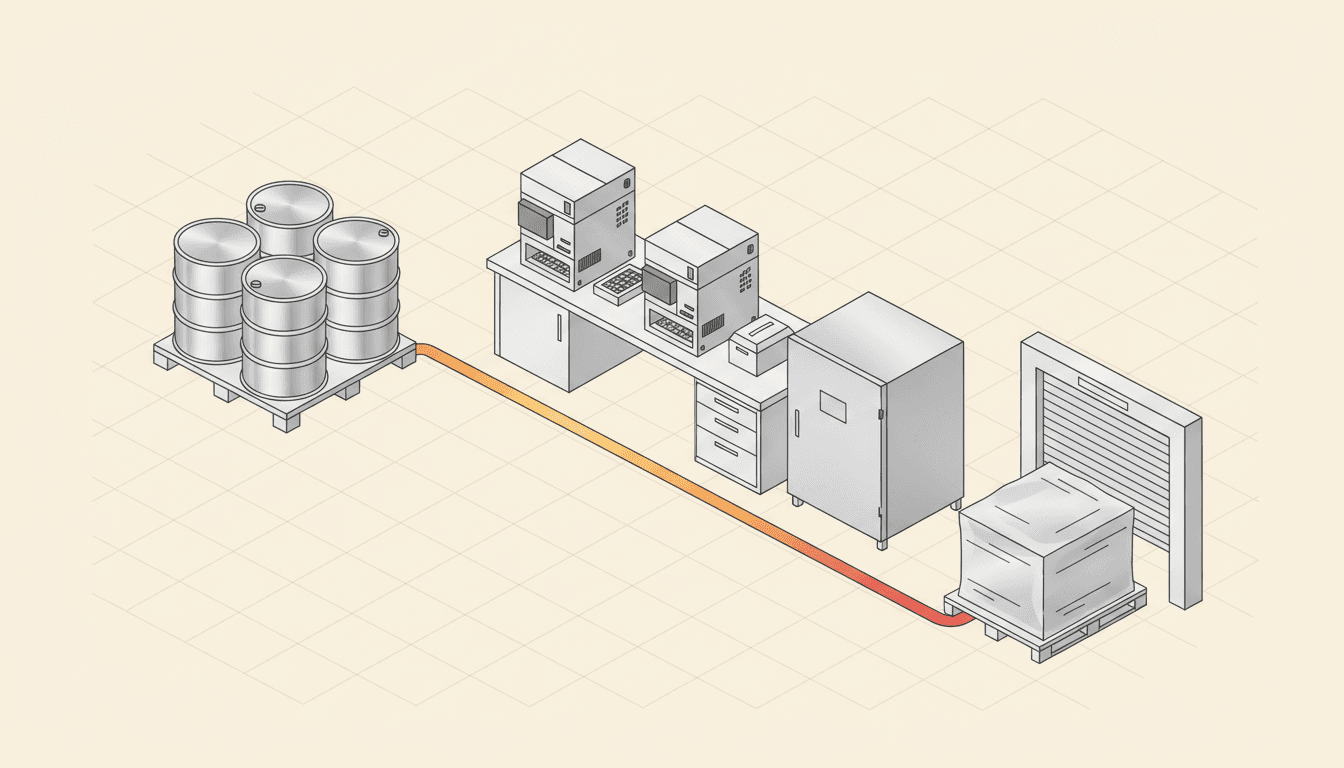
To reduce quality control (QC) release time, plan the waits, not just the tests. After production ends, much of a batch's time goes to waiting: for transport, a queue, an analyst, an instrument and a reviewer. The tests take as long as the method says. The waits get shorter when you rebuild the lab plan every time production or the lab changes.
This guide is for QC lab managers, QC supervisors and Heads of Quality in regulated process manufacturing.
Why does batch release take so long after production?
When production finishes a batch, it still can't ship. Before release it passes through a chain of steps, and each one waits on something different.
In the QC lab:
- The sample is taken and sent. Someone has to carry it to the lab.
- The lab receives it and logs it in the Laboratory Information Management System (LIMS). That needs a person at intake.
- It joins the queue. Other samples got there first, or have a higher priority.
- It is tested. The test needs a qualified analyst and a free, calibrated instrument at the same time.
- The data is reviewed. The analyst checks their own work, then a second person reviews it, including the audit trail. Review needs someone with time to do it.
- The results are approved and the certificate of analysis (CoA) is issued.
Alongside the lab work, Quality Assurance (QA) has its own steps:
- The batch record is reviewed. That needs a reviewer, and any missing entries have to be completed.
- Any deviation on the batch is closed. That waits for the investigation and its sign-off.
One of these two is often the last thing holding the batch.
The final step is the QA decision on the batch. For an active pharmaceutical ingredient (API), the quality unit releases it. For a finished medicinal product in the EU, a Qualified Person (QP) certifies it. In the US, the quality unit approves or rejects each finished drug batch.
Some waits can't be cut. A microbial test needs days of incubation, and the best plan only lets you start it sooner.
Many other waits come from planning. The sample was placed too low in the queue. The only qualified analyst was busy with other work. The instrument was free yesterday but not today. Nobody had set aside time for review. These are the days a lab can recover.
A release date from Monday's queue is a guess by Tuesday
Many labs build the week's queue once, on Monday, then adjust it by hand as the week goes on.
The trouble is that the release date was promised from Monday's queue. When the queue changes, the date quietly stops being true, and nobody says so. Customer service and supply planning are usually the last to hear, and then they have to call the customer with a new date.
Treat a release date as a forecast. It should move when the plan moves, so the date you give a customer comes from today's plan.
That only works if the plan is current. A queue rebuilt each shift or each day can carry a forecast. A queue patched by hand struggles to keep up.
What a lab plan has to hold to stay current
Follow one sample from intake to release, and the plan needs to know a lot at every step:
- Intake. Every sample on one list, with its product, batch, arrival time and need-by date.
- Test plan. The test methods the sample needs, such as a chromatography assay or a microbial limit test.
- Grouping. Samples that run on the same instrument, grouped so each run uses its capacity.
- Activities. Each method broken into its steps: hands-on work, instrument time and the review task.
- People. Each step given to an analyst who is qualified for it, across shifts.
- The day. A live view for the QC supervisor of who is on what, and what is late.
When all six live in one plan, a change at any step shows up everywhere it matters. When they're split across a spreadsheet, a LIMS list and the supervisor's own notes, the supervisor joins them up by hand, week after week. That's time they could spend with their team and on the problems only they can solve.
Samples with a time limit: in-process control (IPC) and stability
Some samples come with a clock. There are three kinds, and they work differently:
- Sample hold time. Some tests must start within a set time after sampling, sometimes 24 hours or less. Miss it and the result may not be valid, so a new sample is needed.
- IPC results. Production may need a result before the next step can start. This matters to the QC lab when the IPC sample comes to the lab, rather than being tested at the line.
- Stability pulls. A stability pull means taking a sample out of a stability study at a set time point. The study protocol sets the due dates, the site's procedure sets the window for each pull, and after the pull the testing has to finish within a set period.
Put each of these in the plan as a hard limit, with time booked against it. Tie each IPC pull to the production step that creates it. Plan stability pulls from the protocol calendar weeks ahead, with analyst and instrument time set aside.
How to keep the QC schedule in sync with production
A batch finishes four hours early. Another runs four hours late. On Wednesday afternoon the production plan changes.
Each change moves work in the lab: when samples arrive, which analysts and instruments are booked for them, when IPC pulls happen, and the release dates that depend on all of it.
In many plants the lab hears late. Someone notices the samples haven't turned up, or turned up early, and the queue gets rebuilt by hand.
The fix is to plan the lab from the same events as production, so when a batch moves, the lab plan moves with it. We covered the production side in How to reschedule production when a machine breaks down. The same event that moves production reaches QC and maintenance too.
When an out-of-specification (OOS) result lands
Say an assay result comes back out of specification on Tuesday.
An OOS result doesn't trigger a retest. It triggers a lab investigation. A retest or a new sample can come later, and only as the site's procedure allows. The batch can't be released until the investigation closes.
The bigger cost to the plan is everything around the investigation. The analyst and supervisor get pulled into it, and an instrument is booked again for it. The samples behind it in the queue wait. A sample with a time limit may miss its window. Three other batches now carry the wrong release date.
What matters is how fast the rest of the queue is rebuilt around the investigation, so those other batches stay on time.
What changes with Bodhee Quality Control Scheduling
Bodhee Quality Control Scheduling rebuilds the lab plan every cycle, whether that's each shift, day or week, rather than patching yesterday's queue.
- The lab is planned as it really runs. Analyst competency, instrument capability, method hold times and batch priority are hard constraints in the plan.
- Every sample type is in one plan. Stability, OOS, IPC and batch release samples each carry their own windows and due dates.
- Lab events are inputs. Sample and test status from the LIMS, and OOS results and deviations from the quality management system (QMS), feed the plan, and the plan is rebuilt around them.
- The lab plan moves with production. Events from Bodhee Production Scheduling trigger QC rescheduling within minutes. The batch release forecast updates, and IPC pull times re-sync. Batch events from a manufacturing execution system (MES) are also an input.
- The lab lead sees the day live. Each analyst's tasks show in real time, work can be reallocated, and overdue tasks and tasks with nobody to run them are flagged.
- It works with the lab's existing systems. It reads sample registration and test status from the LIMS, and connects to the chromatography data system (CDS), MES and QMS. It works with LIMS such as LabWare, LabVantage, STARLIMS and Thermo SampleManager.
It won't shorten a test, a review or an OOS investigation. What it gives back is the time the lab spends re-planning by hand.
See how Bodhee Quality Control Scheduling works
Frequently asked questions
How does an OOS result affect batch release dates?
The batch with the OOS result can't be released until the lab investigation closes. The wider cost is the queue behind it. Analysts, instruments and time-limited samples move, and other batches' release dates slip unless the queue is rebuilt quickly.
How do you forecast batch release dates?
Build the forecast from the current lab plan, not last week's, and update it every time the plan changes. Tell customer service and supply planning when it moves.
Can scheduling shorten QC tests?
No. The method sets incubation times and test steps. Scheduling reduces the waits around the tests: the queue, the order of work, a busy analyst, an instrument that's already booked.
Is data review part of the schedule?
It should be. Second-person review, including the audit-trail review, needs a qualified person with time. In Bodhee Quality Control Scheduling, each method's steps include the review task, so review time is planned with the rest of the work.
Does a QC scheduler replace the LIMS?
No. Bodhee Quality Control Scheduling runs alongside the LIMS. It reads sample registration and test status from it and plans the work around it.
Is Bodhee suitable for good manufacturing practice (GMP) labs?
It is designed to support GMP use. Its own scheduling records are audit-trail-aligned with 21 CFR Part 11 and EU GMP Annex 11. Lab data and its audit trail stay in the LIMS. Compliance is achieved by the validated system at your site, not by the software alone.
Request a Demo
A 30-minute tour of Bodhee Quality Control Scheduling, on a release queue like yours.
Prefer to talk first? Talk to Sales
Bodhee: Dynamic Manufacturing Scheduling
Bodhee delivers dynamic, constraint-aware scheduling for Production, Quality Control, and Maintenance on one live model of your plant.

See it in action
Quality Control Scheduling
Explore the deployments, architecture, and ROI math behind dynamic scheduling for your plant.
See Quality Control Scheduling