
Pharmaceutical Production Scheduling: A Practical Guide
Scheduling a cGMP plant isn't like scheduling any other factory. Cleaning validation, QC release gates, and campaign trade-offs reshape what can run when, and generic schedulers miss all of it.
 7 Aug 20269 min read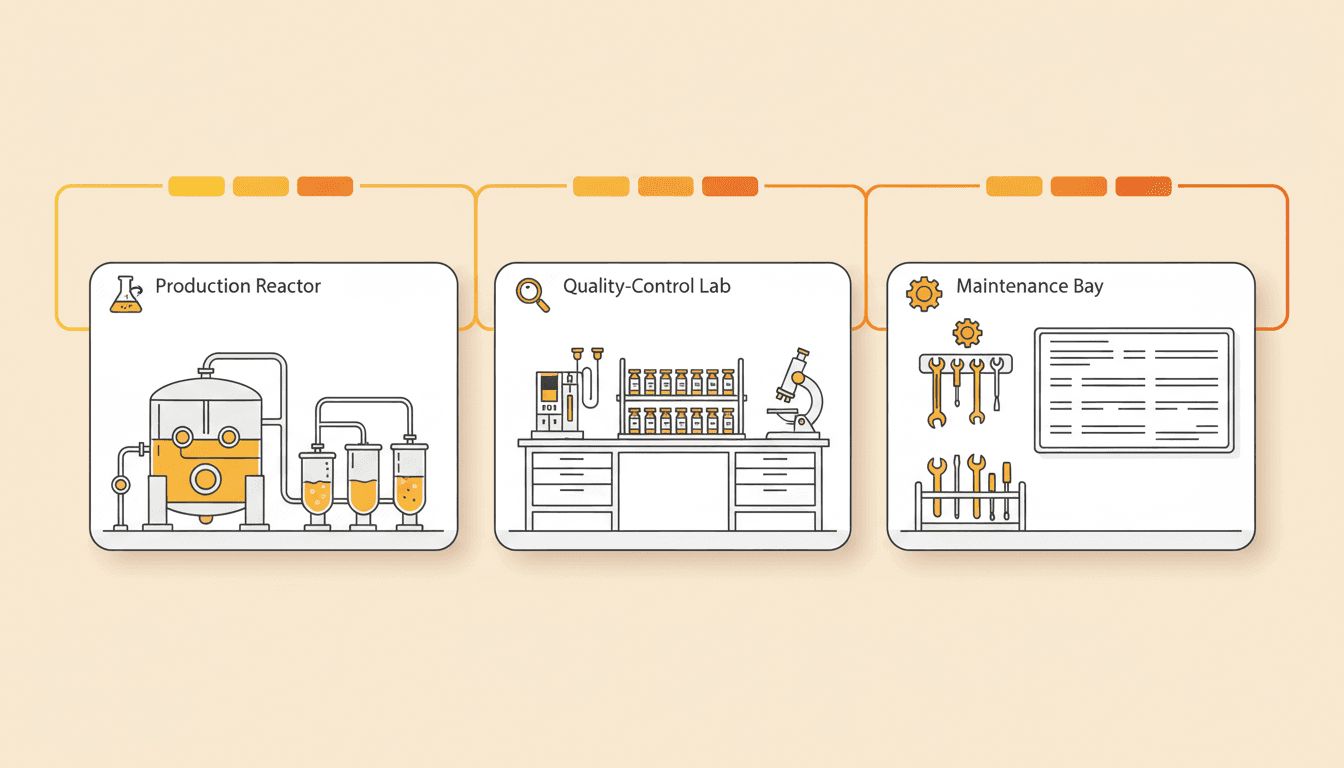
TL;DR: Pharmaceutical production scheduling coordinates batch production, QC release testing, and equipment maintenance under cGMP constraints (cleaning validation, quality release gates, and campaign sequencing) that generic discrete-manufacturing schedulers don't model. The most common failure is Production, QC, and Maintenance each planning in isolation and reconciling only after a conflict. Fixing it means modelling QC and cleaning as real constraints and re-synchronizing the three functions automatically, alongside your existing ERP, MES, and LIMS rather than replacing them.
Scheduling a pharma plant is not like scheduling a plant that makes almost anything else, and anyone who's tried to bolt a generic scheduling tool onto a cGMP pharmaceutical production line has usually found that out the hard way.
This guide is meant to be practical rather than theoretical: what actually makes pharmaceutical scheduling harder, what the common failure points look like in real plants, and what to check for if you're evaluating how to fix it.
Why pharmaceutical production scheduling is harder than other manufacturing
A few things stack up here that don't exist, or don't matter nearly as much, in most other manufacturing:
Cleaning and changeover validation. You can't just wipe down a line and move on. Depending on the product sequence, a changeover might require a validated cleaning procedure, documentation, and sometimes a hold time before the next batch can start. Get the sequence wrong (say, a high-potency product followed by one with tight cross-contamination limits) and you've either created a compliance problem or added hours of unplanned cleaning time nobody scheduled for.
Quality release gates. In most industries, a batch that's done is done. In pharma, a batch that's physically finished still has to clear QC release testing and often a formal batch record review before it can ship, or in some cases before the next batch can even start on the same equipment. That release step isn't a footnote. It's frequently the actual bottleneck, and a schedule that doesn't model it is really just a wish list.
Campaign-based manufacturing. Especially in API and CDMO environments, products often run in campaigns, several batches of the same product back to back, to minimize costly changeovers. But campaigns have to be balanced against customer due dates, shelf life on intermediates, and equipment availability across multiple concurrent campaigns. Get the campaign length wrong and you're either changing over too often (expensive) or holding customer orders too long (worse).
Regulatory documentation as a scheduling constraint, not an afterthought. Batch records, electronic signatures, and audit trails: these aren't just paperwork that happens after production. They shape what can run when, who has to be available to sign off, and how quickly a batch can actually move to the next step.
The most common pharma scheduling failure: Production, QC, and Maintenance out of sync
Talk to enough plant managers in pharma manufacturing and you'll hear some version of the same story: Production has a schedule that makes sense. QC has one too. So does Maintenance. The problem is that the three rarely agree with each other.
Here's how it usually plays out. Production books Batch A for a 2pm run. Nobody's told QC, so the lab hasn't planned for the release testing that batch will need by 6pm. Meanwhile Maintenance has a preventive maintenance slot booked on that same line at 3pm, because the conflict was never flagged to begin with. Nobody notices any of this until it's already happening, and the rest of the day turns into damage control.
None of this is really down to one person messing up. It's just what happens when three functions are each planning on their own, whether that's separate tools or the same spreadsheet getting updated by different people at different times. The only time anyone compares notes is after something's already gone wrong.
What to look for in pharmaceutical scheduling software
If you're evaluating how to fix this, a few things are worth checking specifically, because generic scheduling tools built for discrete manufacturing often miss them:
Does it actually model QC and lab capacity as a real constraint? Not as a note in a spreadsheet cell, but as a genuine resource the schedule accounts for, the same way it accounts for machine time.
Does it handle changeover and cleaning validation rules explicitly? A tool that treats every changeover as roughly equal time will eventually schedule a sequence a validated cleaning procedure doesn't allow. It needs to know which product-to-product transitions demand a validated clean, documentation, or a hold time, and refuse the ones that don't comply.
Does it then schedule those cleaning and validation activities against finite operator capacity and skills? Handling the rule is only half of it. The clean still has to be done by a qualified operator who is actually available. Industry figures put planned losses (cleaning, changeover, validation) at 30% or more of staffed time, and in several of our own pharma implementations, indirect and non-production tasks have run around 17% and up. Model those against real operator capacity and skill requirements, and the hit to production capacity becomes manageable instead of a surprise.
Can it re-synchronize Production, QC, and Maintenance automatically when one of them changes? This is the real test. If QC gets delayed by two hours, does the production schedule (and the maintenance window, and everything downstream) update on its own, or does someone have to notice and manually fix three separate schedules?
Is it built to sit alongside your existing systems, not replace them? Most GMP facilities have already validated their ERP, MES, and LIMS. A scheduling approach that requires ripping those out is usually a nonstarter and honestly shouldn't be necessary. The right layer complements what's already there instead of competing with it.
How to start fixing pharma scheduling: a practical first step
If your plant is dealing with the Production-QC-Maintenance mismatch described above, the fastest way to find out where you actually stand is to track, for a couple of weeks, every time a schedule had to be manually reworked because one function's plan didn't match another's. Most plants are surprised by how often it happens once they actually count it.
That number, more than any theoretical ROI calculation, is usually what makes the case for changing how scheduling gets done.
Start any tool implementation by mapping the process at a high level first, then work down into more granular activities phase by phase, unlocking capacity as you go. That phased approach tends to work far better than trying to implement everything in one big-bang rollout.
Treat skill-level constraints as something you phase in over time, not something you dump on the team on Day 1 of a new scheduling tool rollout. In most plants, the skill master and skill matrix data already exist somewhere, usually in spreadsheets or in an LMS. What's almost never available in one central place is the mapping of skills to tasks. Process engineers tend to keep that in their own spreadsheets, and shift leaders usually track which operator does which task rather than which skill each task needs, so pulling that mapping together is often the real first step, not an afterthought.
Frequently asked questions
Why is pharmaceutical scheduling harder than other manufacturing?
Four constraints that barely register elsewhere dominate here: validated cleaning and changeover procedures that depend on product sequence, quality release gates that hold a finished batch until QC clears it, campaign trade-offs against due dates and intermediate shelf life, and regulatory documentation that decides what can run when. Generic discrete-manufacturing schedulers don't model any of them.
What is the most common scheduling failure in pharma plants?
Production, QC, and Maintenance each plan on their own, in separate tools or separate spreadsheets, and only compare notes after a conflict has already happened. A batch booked without telling the lab, a maintenance slot dropped onto a line mid-run, a release test nobody planned for: the day turns into damage control because no single schedule saw all three functions at once.
How much plant capacity do non-production tasks consume?
Industry figures put planned losses from cleaning, changeover, and validation at 30% or more of staffed time. In several of our own pharma implementations, indirect and non-production tasks have run around 17% and up. Scheduling those activities against real operator capacity and skills, rather than treating them as fixed buffers, is where a lot of that capacity becomes recoverable.
Does pharma scheduling software need to replace ERP, MES, or LIMS?
No. Most GMP facilities have already validated their ERP, MES, and LIMS, and ripping them out is usually a nonstarter. The right scheduling layer sits alongside those systems and complements them, rather than competing with what's already validated.
What should you look for in a pharmaceutical scheduling tool?
Check whether it models QC and lab capacity as a real constraint, handles cleaning and changeover validation rules explicitly, schedules those activities against finite operator capacity and skills, re-synchronizes Production, QC, and Maintenance automatically when one changes, and runs alongside your existing ERP, MES, and LIMS instead of replacing them.
This is the problem Bodhee is built around: keeping Production, Quality Control, and Maintenance schedules in sync in real time, without replacing the ERP, MES, or LIMS already validated in the plant. It's ISO 27001 certified and built with audit-trail alignment to 21 CFR Part 11, Annex 11, and GAMP 5 in mind, which matters the moment this goes near a validated GMP environment.
See Bodhee keep your schedules in sync
A 30-minute working session with a solutions engineer who has shipped this in a regulated plant. We'll use your own Production-QC-Maintenance mismatch, not a generic demo.

See it in action
Production Scheduling
Explore the deployments, architecture, and ROI math behind dynamic scheduling for your plant.
See Production Scheduling