
Where scheduling really sits on the BioPhorum DPMM: why most plants score Level 2
Run a DPMM self-assessment on your plant and scheduling almost always lands at Level 2, Digital Islands. The gap to Connected and Predictive isn't a tool problem. It's a cross-functional one.
 7 Jul 20268 min read
Sit down with a pharma site's digital-transformation lead, open the BioPhorum Digital Plant Maturity Model, and work through the scheduling line items honestly. The score comes back the same almost every time: Level 2. Digital Islands.
Not because the plant is behind. It has a capable ERP, a validated LIMS, a working CMMS. Each system is modern. Each is doing its job. The score is Level 2 because those systems each hold a different plan for the same plant, and nothing reconciles them except people in a meeting.
That is the interesting thing about assessing scheduling maturity: the gap that keeps most plants at Level 2 isn't a missing tool. It's the seam between the tools they already own.
This piece is published by Neewee, which builds Bodhee, adaptive scheduling software for production, quality control, and maintenance in process manufacturing. We map Bodhee onto the DPMM below, and we'll be specific about where that mapping stops, because the ceiling is the honest part of the story.
How the DPMM actually scores scheduling
The BioPhorum Digital Plant Maturity Model & Assessment Tool is a structured way for a biomanufacturing or process site to rate its own digital maturity across a set of business and enabling capabilities, from Level 1 to Level 5:
| Level | Name | What it looks like on the floor |
|---|---|---|
| 1 | Pre-digital | Paper, spreadsheets, tribal knowledge |
| 2 | Digital Islands | Good systems, each in its own silo, no shared plan |
| 3 | Connected | Systems exchange data; plans start to align |
| 4 | Predictive | Scheduling integrated across functions on real-time data |
| 5 | Adaptive | The plan re-optimises itself; execution runs autonomously |
Scheduling doesn't sit in one box on the model. It shows up across three different capabilities, each of which carries a scheduling line item:
- Supply chain → production planning and scheduling
- QC labs → lab scheduling
- Manufacturing support → maintenance and calibration, finite scheduling
The scoring method is where the model earns its precision. Each level has a set of criteria, and the DPMM scores how many of them you actually meet: a Harvey-Ball fill from 0 to 100%, then averaged. You don't "reach Level 4." You meet some fraction of Level 4's criteria, and the model shows the partial fill honestly. That nuance matters for what follows, because the honest answer to "how mature is our scheduling?" is rarely a whole number.
Why scheduling lands at Level 2 for most plants
Level 2 (Digital Islands) is a precise diagnosis, not an insult. It describes a plant where production is planned in one system, QC testing sequenced in another, and maintenance scheduled in a third. Three plans. One plant. Each plan is internally rational and locally optimised. None of them knows what the other two just changed.
The islands hold until something moves. A batch slips. An out-of-specification result lands and pulls analyst capacity sideways. A line goes down mid-campaign. At that moment the three plans disagree, and the plant absorbs the difference. Equipment sits idle waiting on a plan that already changed, and release dates quietly slip while everyone reconciles by hand.
That reconciliation cost is the Digital Islands tax. Cross-functional scheduling misalignment runs on the order of 10–15% of capacity in our experience. It is directional, and every plant's number is different, but it is rarely small and almost never measured. (We've argued the economics of that hidden cost separately in The silo tax.)
The reason plants stay at Level 2 on scheduling isn't inertia. It's that climbing to Level 3 and Level 4 requires the three islands to share one plan, and no single system in the standard stack owns that job.
Three line items, one axis
Read the Level 4 criteria for those three scheduling line items side by side and something jumps out: they are asking for the same thing in three different vocabularies.
- Production planning at Level 4 wants scheduling integrated across the shop floor, driven by real-time data.
- Lab scheduling at Level 4 wants QC sequencing integrated with production and materials, driven by real-time data.
- Maintenance and calibration at Level 4 wants finite scheduling of work integrated with production and the labs, driven by real-time data.
Three line items. One underlying requirement: scheduling integrated across shop floor, labs, maintenance and logistics, on live data.
Most plants can't satisfy any of the three, for the same structural reason: the production scheduler, the QC scheduler, and the maintenance scheduler are three separate islands. You cannot integrate scheduling across functions by improving each function's scheduling in isolation. The criterion lives on the seam, not inside any one box.
This is why "buy a better production scheduler" doesn't move the DPMM score the way people expect. It sharpens one island. The Level 4 criteria are about the water between them.
What full Level 4 looks like, and where Bodhee stops
Bodhee is built to satisfy that shared Level 4 requirement directly. It's a single event-driven model of the plant that all three scheduling functions run on. An event in one function (a delayed batch, an OOS result, a line stoppage) triggers synchronised rescheduling across the other two, in minutes rather than in the next reconciliation meeting.
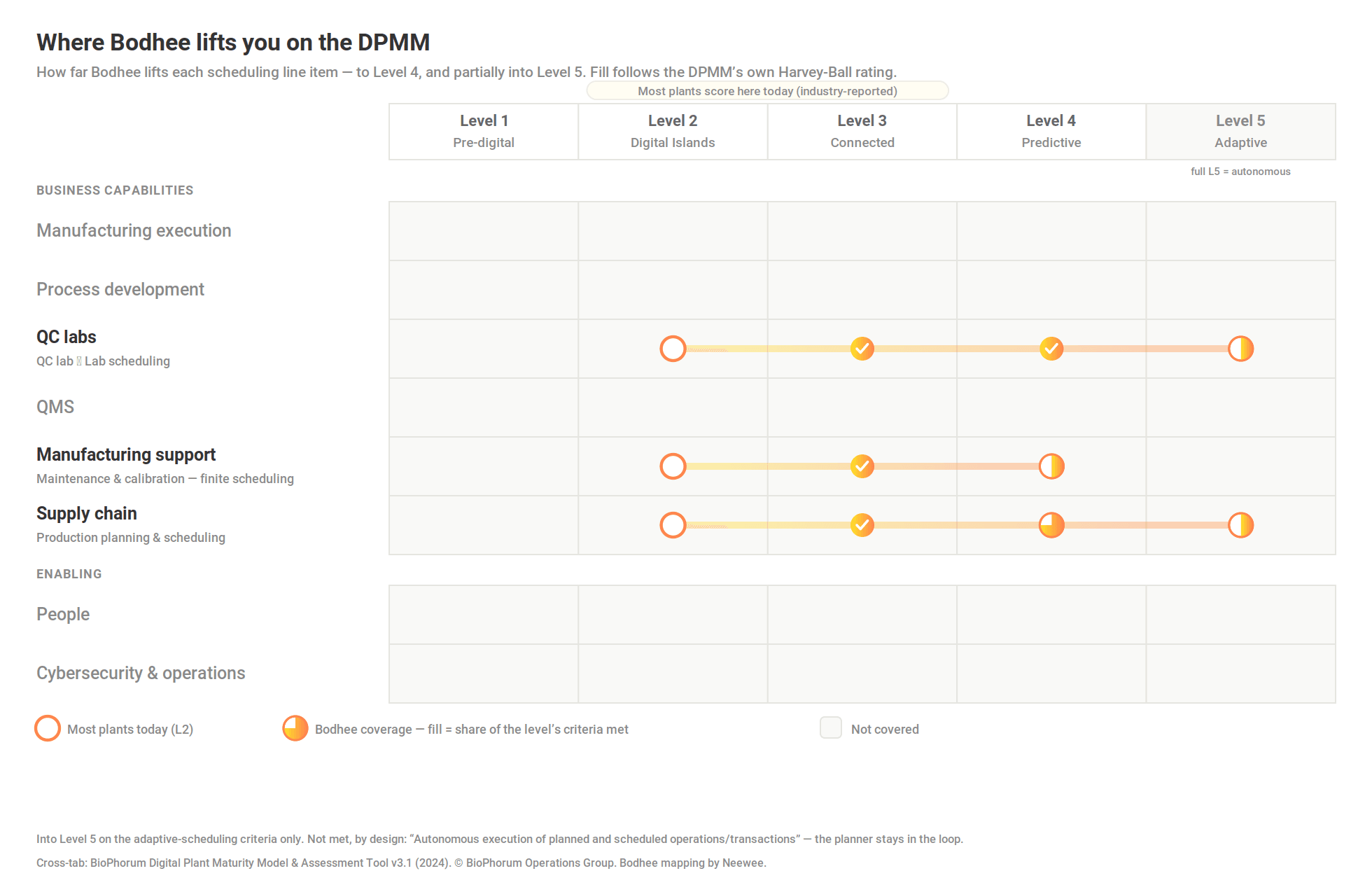
Mapped onto the DPMM, that lifts each of the three scheduling line items off the Level 2 island:
| Scheduling line item | Most plants today | With adaptive scheduling |
|---|---|---|
| Production planning & scheduling | Level 2 | Level 3, into Level 4 |
| Lab scheduling | Level 2 | Level 3, into Level 4 |
| Maintenance & calibration, finite scheduling | Level 2 | the finite-scheduling thread of Level 4 |
Here is the part a brochure would leave out.
Because the DPMM scores each level's criteria and averages them, the honest read of an event-driven scheduler is: full Level 4, and partially into Level 5. A schedule that re-optimises itself from real-time data is meeting Level 5's adaptive-scheduling criterion. That's real, and we'll claim it.
But Bodhee stops one criterion short of full Level 5, and it does so by design. The Level 5 criterion it does not meet is "autonomous execution of planned and scheduled operations and transactions." Full Level 5 takes the human out of the loop: the schedule not only re-optimises but releases and executes itself, hands-off, with electronic signatures applied by the system.
Bodhee keeps the planner in control. It computes the re-optimised schedule and puts it in front of a person to release. No hands-off execution. No autonomous e-signature. In a validated pharma environment, that is the line you don't cross yet, and a scheduler that quietly claimed to cross it would be the wrong tool, not the more advanced one.
There's a second reason the score stops where it does, and it's about scope rather than ambition. Bodhee owns the scheduling line item within each capability, not the whole capability. Supply chain also scores supply, demand, and transportation. QC labs also score lab execution and data integrity. Bodhee moves the scheduling thread; it doesn't pretend to move the entire dimension or lift the whole plant to Level 5. Focus is the point, and a maturity model is exactly the tool that keeps that claim honest.
The maintenance boundary, stated plainly
The maintenance mapping has its own honest edge worth naming. Bodhee Maintenance Scheduling optimises the scheduling of known work orders: clustering and sequencing them into the fewest disruptive windows, synchronised with production and QC. Deciding when a piece of equipment needs attention in the first place stays with the CMMS and the reliability engineers. Bodhee schedules the work order once it exists; it doesn't predict the failure that creates it, and technician allocation stays a human decision by design.
That boundary is why the maintenance line item reaches into Level 4 rather than sitting at its top. It's a scheduling engine, not a condition-monitoring one, and the DPMM makes that distinction visible instead of blurring it.
Reading your own assessment
If your site has run a DPMM self-assessment, or is about to, the useful move is to look at those three scheduling line items together rather than one at a time. Three separate Level 2 scores on production, lab, and maintenance scheduling aren't three separate problems to be fixed by three separate tools. They're one problem showing up in three places: the islands don't share a plan.
The path to Level 3 and Level 4 on scheduling is the same path for all three: a single model of the plant that production, QC, and maintenance schedule against, so that the plans are co-feasible when they're computed rather than reconciled after the fact. That's the structural change. A tool makes it feasible; it doesn't substitute for it.
For sites that make the change, the ranges we see are consistent: OEE up 10–15 percentage points, on-time delivery up 15–25%, scheduling effort down 60–80%, and the rescheduling cycle compressing from hours to minutes. Based on Neewee deployment observations in regulated process manufacturing; individual results vary. Bodhee deploys alongside the existing ERP, LIMS, and CMMS (SAP or Oracle on production, LabWare, LabVantage or STARLIMS on QC, SAP PM, IBM Maximo or Infor EAM on maintenance) rather than replacing any of them. The islands stay; the plan gets unified across them.
The DPMM is a good mirror precisely because it refuses to round up. Score your scheduling honestly, look at the three line items on one axis, and the Level 2 that comes back stops looking like a grade and starts looking like a map.

See it in action
Production Scheduling
Explore the deployments, architecture, and ROI math behind dynamic scheduling for your plant.
See Production Scheduling