
Master data drift — the quiet killer of every scheduling rollout
The day you go live is the day your scheduling model starts decaying. Routings move, BOMs change, equipment swaps in. Nobody tells the planner. Six months later the schedule looks fine and runs nothing like the plant.
 5 May 20267 min read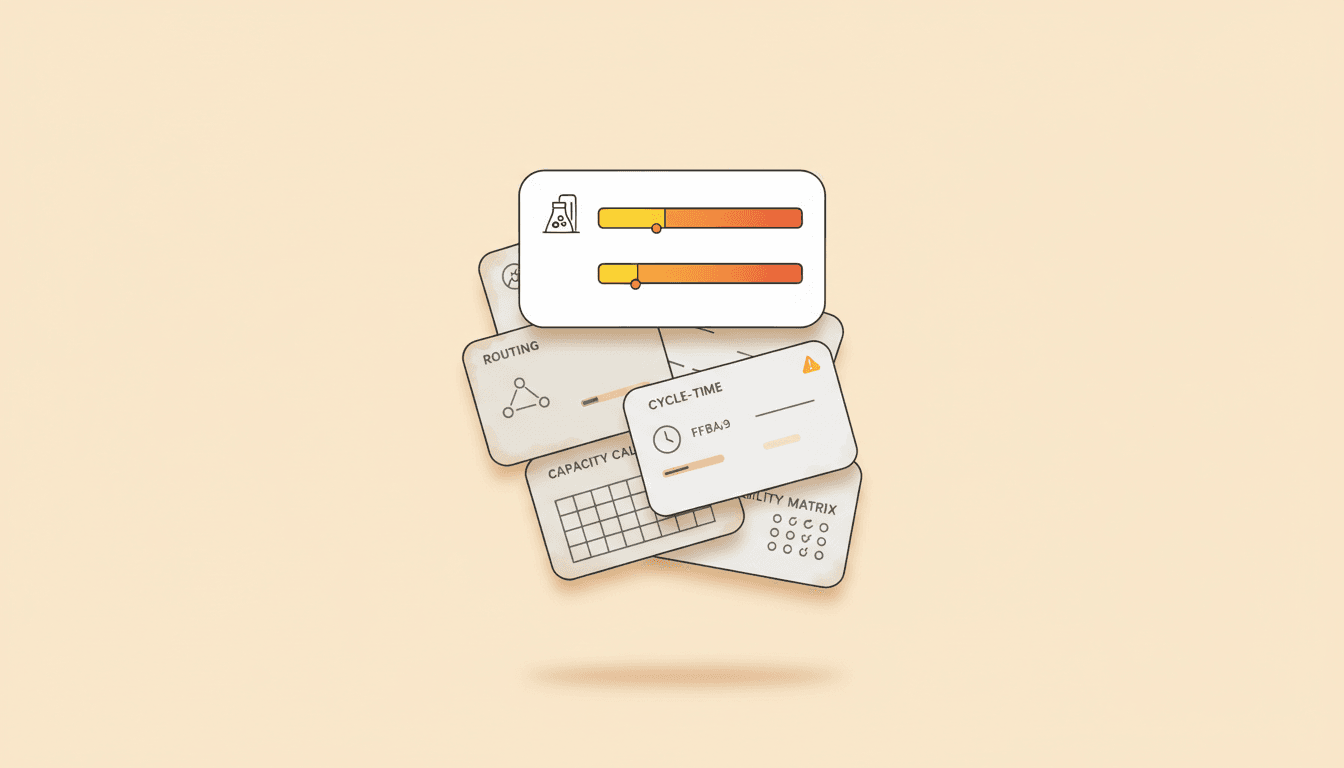
A scheduling system does not fail loudly. It fails the way a clock loses time — a few seconds a day, then a minute, then enough that the noon train is now the 11:53.
The scheduling rollouts that disappoint, in our experience, almost never disappoint at go-live. They disappoint at month four. The planner stops trusting the schedule. The plant goes back to running a parallel spreadsheet. The vendor gets blamed for "the model not matching reality" — which is true, but the vendor isn't what changed.
What changed is the master data underneath the model. And almost nobody owns it.
What master data actually means in a scheduling context
For a scheduler, "master data" isn't the polite definition you get in an SAP brochure. It is the specific set of facts the scheduling engine reads every run to decide what is feasible:
- Routings. Which operations happen on which resources, in which order, with what alternates.
- Cycle times and changeovers. Per product · per resource · per from-to combination.
- Resource capacity calendars. Shift patterns, planned maintenance windows, holidays, plant-specific exceptions.
- BOMs and yields. Especially yield variance, because a 96% yield assumption is a different schedule than a 92% yield assumption.
- Capability matrices. Which operator group, qualification, or cleaning state is required where.
- Constraint parameters. Min/max batch sizes, campaign rules, sequence-dependent setup hierarchies.
The scheduling engine treats every one of these as fact. It has no way to tell that the cycle time it's using was measured on a piece of equipment that was replaced eight months ago.
How drift starts
Drift never announces itself. A representative six months looks like this:
Week 2: A maintenance team swaps a heat exchanger on Reactor 4. Throughput on the polymer line is now 6% slower for the affected SKUs. This information lives in a maintenance work order. The scheduling master data is not touched.
Week 9: A formulation change is approved for Product A — new excipient, slightly different mixing time. The R&D handover updates the MES recipe. The scheduling routing still uses the old cycle time.
Week 14: A new operator-qualification matrix goes live in the LMS. Two products that previously could run on Line 3 now require a more senior qualification that only two operators hold. Scheduling continues to plan against the old capability matrix.
Week 22: Plant adds a fourth shift on weekends to chase volume. The capacity calendar in scheduling still reflects three-shift operation.
None of these are bugs. They are normal plant life. They are also four cumulative reasons the schedule the planner sees on screen is not the schedule the plant can run.
Why nobody catches it
The structural problem is ownership. Master data for scheduling sits across at least four organisations:
| Data type | Lives in | Owned by | Updated when |
|---|---|---|---|
| Routings, BOMs | ERP / MES | Process engineering | Engineering change |
| Cycle / changeover times | Historian, MES, often a planner's spreadsheet | Operations / IE | Continuous improvement, equipment changes |
| Capacity calendars | Scheduling tool itself | Plant scheduling team | Shift changes, maintenance plans |
| Capability matrices | LMS / training systems | HR / quality | Operator qualification |
The scheduling team owns the output. They rarely own any of the inputs. Each input has its own update cadence, its own change-control process, and — critically — no one whose job description includes "make sure the scheduling engine knows this changed."
So the scheduling system continues to consume the model it was given at go-live, plus whatever has been manually corrected by a planner who happened to notice. That's the drift.
The signs the planner sees
Before the planner explicitly says "this isn't working," there is a stretch of six to twelve weeks of subtle symptoms:
- The schedule keeps proposing sequences that the floor manually re-orders.
- "Re-plan" runs more often. Manual interventions per shift creep upward.
- The variance between planned end-of-day and actual end-of-day grows by 10–20 minutes a week, then plateaus at "an hour or two".
- The planner stops looking at the optimisation score because the score doesn't correspond to anything they recognise.
- Spreadsheets reappear. Always.
By the time the conversation reaches "the scheduling tool isn't matching reality," trust is already gone, and rebuilding it is harder than getting to go-live was.
What to do about it
There is no clever architecture that eliminates this. There are operating practices that contain it. The plants that keep their schedules trustworthy do four things:
Name the steward before go-live
Not after. Before. A specific person — usually senior planner or planning manager — whose accountability includes the integrity of the scheduling master data. Not the integrity of the schedule. The integrity of the inputs to the schedule.
If no one's name is in the box, the answer to "who keeps this current?" is "nobody," and you can predict the rest.
Wire change events in, don't poll
Every time engineering issues a change order, every time a recipe is approved, every time an operator qualification record changes, the scheduling system should hear about it. Not on a quarterly export. On the event. In a regulated environment that's a controlled interface; in less regulated ones it's a webhook. Either way, drift compounds at the speed of unnotified changes.
Recalibrate quarterly, audit annually
Cycle times measured at go-live are not cycle times today. A simple quarterly job — pull actuals from the historian, compare to the master-data values, surface the deltas — keeps the model honest. Once a year, run a fuller audit that includes routings, alternates, and the capability matrix.
Make the planner the customer of the change-control process
The planner should receive the same change notifications that production, quality, and engineering receive. They should have to confirm "scheduling master data updated to reflect change X" as part of the change closure. If the change closes without that confirmation, the change isn't closed.
What this means for selecting a scheduling system
The instinctive question when buying a scheduling tool is "what does the optimiser do?" The better question, by month six, is "what does this tool do to keep its master data honest?"
Listen for:
- Native consumption of MES / ERP master data, not a one-time import.
- Versioning of the scheduling model — when did this routing change, who changed it, what was it before.
- The ability to flag deltas between planned and actual times automatically, not on demand.
- A clean way to retire a piece of equipment from the model without leaving zombie routings behind.
A scheduler that ships without these is a scheduler whose accuracy will live entirely on the discipline of one person.
The summary your operations director needs
Master data drift is the largest single reason scheduling rollouts fail to deliver year-two results. It is preventable but not by accident. Name the steward, wire the change events, recalibrate on a fixed cadence, and put the scheduling team inside the change-control loop. Otherwise, six months from go-live, you will be looking at a clean schedule on a screen and a noisier plant on the floor, and you will not be sure why.

See it in action
Production Scheduling
Explore the deployments, architecture, and ROI math behind dynamic scheduling for your plant.
See Production Scheduling